You are mid-conversation at a family dinner. Everyone else is laughing. You smiled, nodded – but you missed the punchline entirely.
That moment happens to over 1.5 billion people worldwide living with some degree of hearing loss. And yet, most of them wait an average of 7 years before seeking help.
Not because they do not care. But because hearing loss is silent, gradual, and deeply misunderstood.
This guide changes that. Whether you are noticing the first signs yourself, supporting a loved one, or simply trying to understand what hearing loss actually means – this is the most complete, honest breakdown you will find. We cover every type of hearing loss, what causes it, how to recognize it early, and the modern solutions available today – including ones you can start using right now, on the phone already in your pocket.
What Is Hearing Loss?
Hearing loss is the reduced ability to detect or process sounds that would normally be audible. It is not a single condition – it is a spectrum.
You might experience it as:
- Struggling to follow conversations in noisy environments
- Constantly asking people to repeat themselves
- Turning the TV volume up higher than others prefer
- Missing high-pitched sounds like birds or doorbells
- A constant ringing or buzzing in the ear (tinnitus)
Hearing loss can be mild, moderate, severe, or profound. It can affect one ear or both. It can come on suddenly or develop so gradually you barely notice – until one day, you realize how much you have been missing.
The World Health Organization estimates that by 2050, nearly 2.5 billion people will have some degree of hearing loss. It is one of the most common sensory conditions in the world – and one of the most manageable when caught early.
The Three Types of Hearing Loss
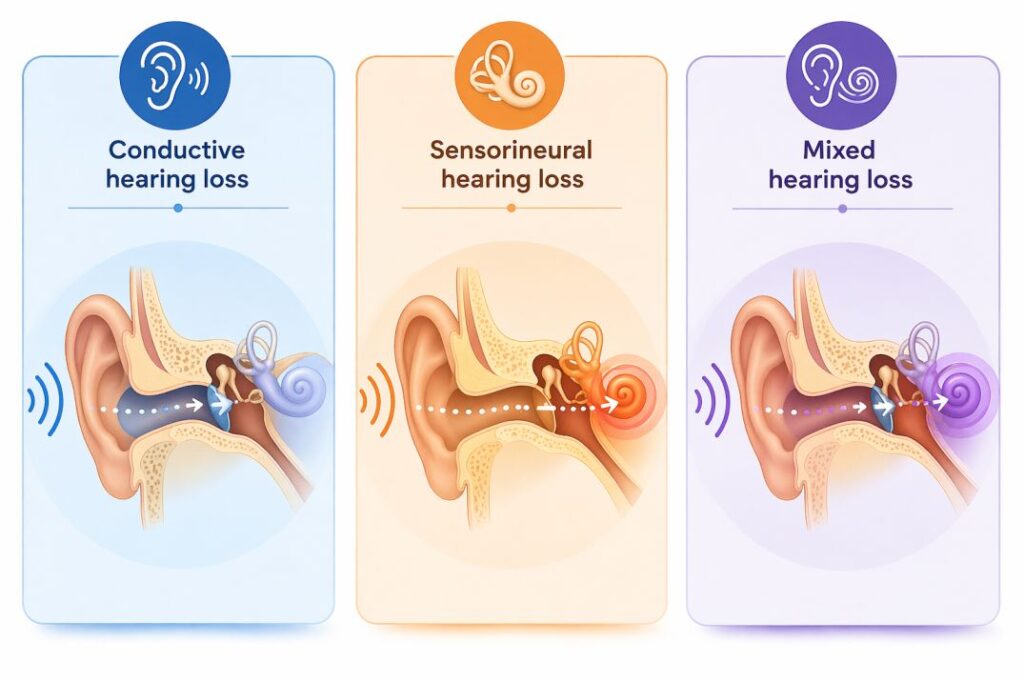
Understanding which type you or a loved one has is the first step toward finding the right solution.
1. Conductive Hearing Loss
Conductive hearing loss happens when sound cannot travel efficiently through the outer or middle ear to reach the inner ear. Something is physically blocking or damping the signal.
Common causes:
- Earwax buildup (cerumen impaction)
- Fluid or infection in the middle ear (otitis media)
- A perforated eardrum
- Abnormal bone growth (otosclerosis)
- Foreign objects in the ear canal
What it sounds like: Sounds feel muffled, distant, or like you are hearing through water. Both soft and loud sounds are affected equally.
The good news: Conductive hearing loss is often temporary and treatable. In many cases, clearing the blockage – whether through medication, minor surgery, or a simple earwax removal – restores hearing fully.
2. Sensorineural Hearing Loss
This is the most common type – affecting around 90% of adults with hearing loss. It involves damage to the hair cells inside the cochlea (inner ear) or to the auditory nerve that carries signals to the brain.
Unlike conductive loss, sensorineural damage is usually permanent. The hair cells do not regenerate.
Common causes:
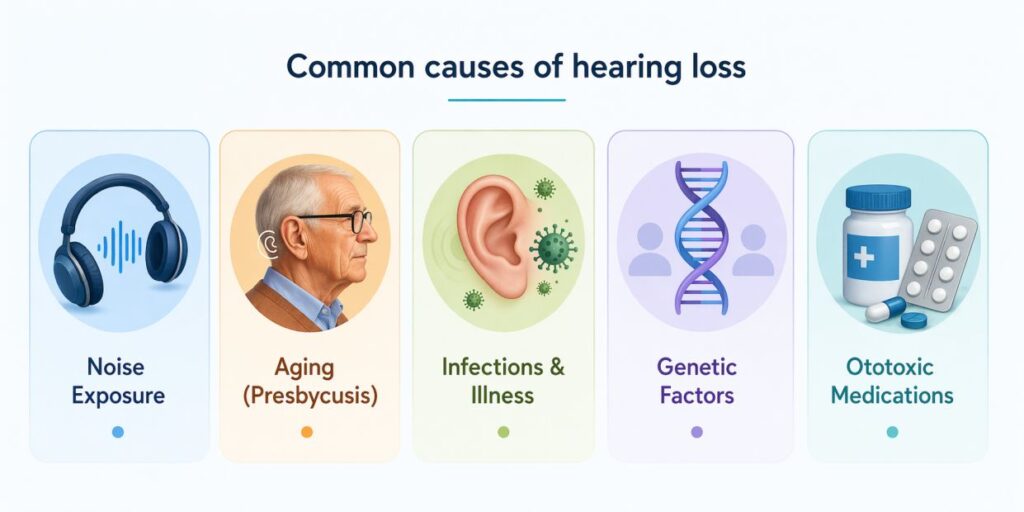
- Prolonged exposure to loud noise
- Natural aging (presbycusis)
- Certain medications (ototoxic drugs)
- Viral infections like mumps or meningitis
- Genetic factors
What it sounds like: You can hear people speaking, but their words sound unclear or distorted. High-pitched sounds – like consonants (f, s, th) – become hard to distinguish. Conversations in background noise become exhausting.
Management: While the damage cannot be reversed, sensorineural hearing loss is highly manageable with hearing aids, assistive technology, and sound amplification apps.
3. Mixed Hearing Loss
Mixed hearing loss is exactly what it sounds like – a combination of both conductive and sensorineural components. You might have underlying inner ear damage, compounded by an additional blockage or infection in the outer or middle ear.
Example: Someone with age-related inner ear damage who also develops an ear infection will experience mixed hearing loss until the infection clears – at which point only the sensorineural component remains.
Treatment typically addresses both components: the conductive part may be treatable; the sensorineural part is managed with amplification.
The Most Common Causes of Hearing Loss
Noise-Induced Hearing Loss (NIHL)
This is entirely preventable – and devastatingly common.
Exposure to sounds above 85 decibels for extended periods damages the delicate hair cells in your cochlea. Once those cells are gone, they do not grow back.
To put that in context:
- Normal conversation: ~60 dB
- City traffic: ~85 dB
- Concerts or nightclubs: ~110 dB
- Gunshot or explosion: ~140 dB
The danger is that noise-induced damage is painless and cumulative. You do not feel it happening. You notice it years later, when words start to blur together.
Prevention is simple: Use ear protection in loud environments. Keep headphone volumes below 60% of maximum. Take listening breaks.
Age-Related Hearing Loss (Presbycusis)
Hearing loss due to aging is natural and extremely common. Around one in three people over 65 and one in two over 75 experience significant age-related hearing decline.
The cochlea gradually loses sensitivity, particularly in the high-frequency range. This is why older adults often struggle to hear women’s and children’s voices more than men’s – and why consonants become harder to distinguish than vowels.
It is not a sign of weakness. It is biology. And it is very manageable.
Genetic and Congenital Causes
Around 1 in 500 newborns is born with some degree of hearing loss. Roughly half of congenital hearing loss has a genetic cause.
Some genetic forms are syndromic – meaning hearing loss appears alongside other conditions (like Usher syndrome or Waardenburg syndrome). Others are non-syndromic – hearing loss occurs in isolation, without other associated conditions.
Early identification through newborn hearing screening programs is critical. Children who receive early intervention – whether through hearing aids, cochlear implants, or language support – develop communication skills significantly better than those who receive help later.
Illness, Infection, and Medication
Several illnesses can damage hearing, either directly or through inflammation:
- Meningitis – can cause sudden, severe hearing loss due to inflammation of the auditory nerve
- Mumps – a leading cause of sudden unilateral (one-sided) hearing loss
- Otitis media (middle ear infection) – especially in children; usually causes temporary conductive loss
Certain medications are ototoxic – meaning they can damage the inner ear as a side effect. These include some chemotherapy drugs (cisplatin), high-dose aspirin, certain antibiotics (aminoglycosides), and loop diuretics.
If you are prescribed any of these medications, ask your doctor about monitoring your hearing during treatment.
How to Recognize the Early Signs of Hearing Loss
Most people do not lose their hearing overnight. It fades – slowly, silently. Here are the early warning signs to watch for:
In adults:
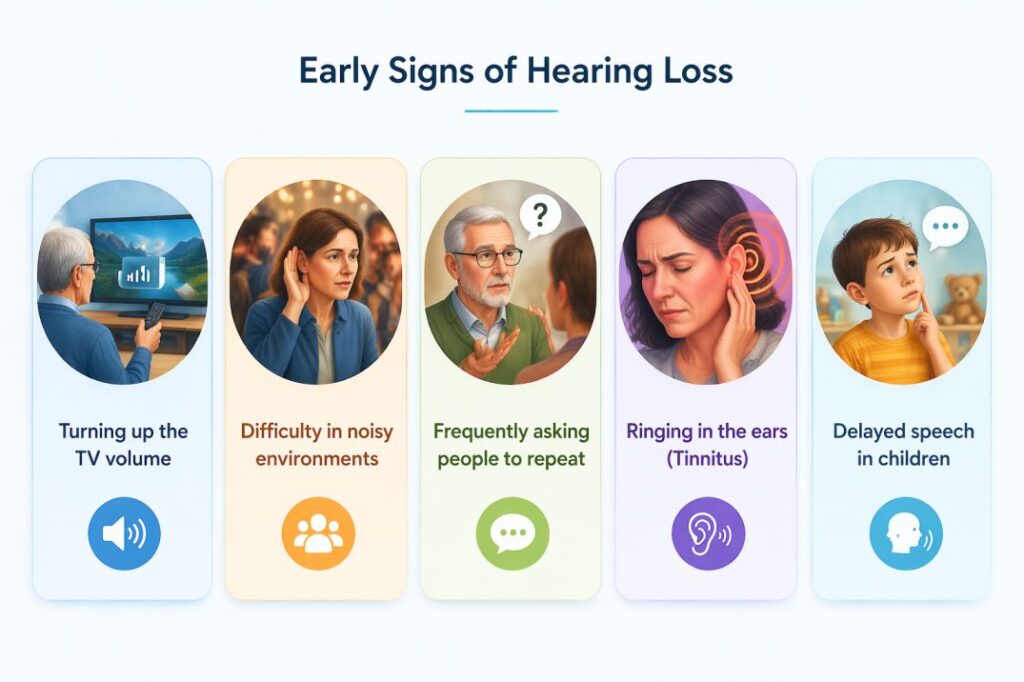
- Frequently asking people to repeat themselves
- Difficulty following conversations when there is background noise
- Turning the TV or radio up louder than others prefer
- Missing phone calls or doorbells
- Feeling like others are mumbling
- Ringing, buzzing, or hissing in the ear (tinnitus)
- Withdrawing from social situations that used to feel easy
In children:
- Delayed speech or language development
- Not responding to their name being called
- Watching others before copying an action (compensating for missed verbal cues)
- Frequent ear pulling or complaints of ear pain
- Teachers reporting inattentiveness or poor responses in class
If you recognize three or more of these signs in yourself or someone you love – do not wait. Early action makes an enormous difference.
Diagnosing Hearing Loss: What to Expect
If you suspect hearing loss, a hearing evaluation is the place to start. Here is what typically happens:
Otoscopy – A doctor looks into your ear canal with a light to check for visible problems like earwax, infection, or a perforated eardrum.
Pure-tone audiometry – You wear headphones and press a button when you hear a tone. This maps your hearing across different frequencies and volumes, producing an audiogram – a visual chart of your hearing ability.
Speech audiometry – Tests how well you understand spoken words at different volumes, separate from the ability to detect pure tones.
Tympanometry – Measures the movement of your eardrum in response to air pressure, detecting problems in the middle ear.
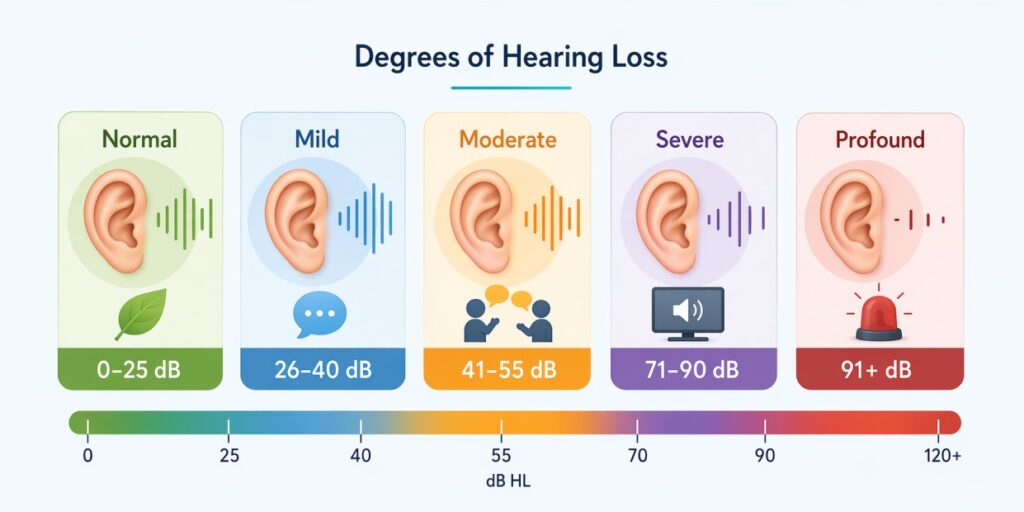
Results are categorized as:
- Normal: 0–25 dB hearing loss
- Mild: 26–40 dB
- Moderate: 41–55 dB
- Moderately severe: 56–70 dB
- Severe: 71–90 dB
- Profound: 91+ dB
An audiologist will walk you through your results and discuss what options are appropriate for your degree of loss.
Modern Solutions for Hearing Loss
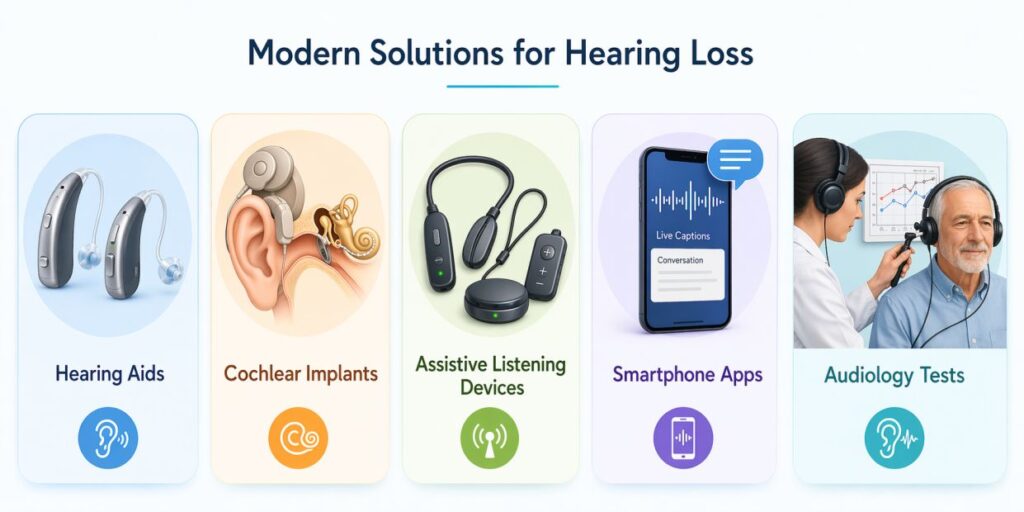
The landscape of hearing loss management has changed dramatically in the last decade. Solutions range from clinical devices to everyday smartphone tools – and there is something at every budget and lifestyle.
Traditional Hearing Aids
Hearing aids have come a long way from bulky, whistling devices of the past. Today’s hearing aids are:
- Discreet (some are nearly invisible in the ear canal)
- Rechargeable (no more fiddly tiny batteries)
- Bluetooth-enabled (stream audio directly from your phone or TV)
- AI-powered (automatically adjust to different environments)
Types include:
- Behind-the-ear (BTE) – Powerful, suitable for severe loss
- Receiver-in-canal (RIC/RITE) – Discreet, excellent sound quality
- In-the-ear (ITE) – Fits inside the ear, easier to handle for older adults
- Completely-in-canal (CIC) – Nearly invisible, for mild to moderate loss
- Invisible-in-canal (IIC) – The most discreet option available
The main limitation: cost. Premium hearing aids can cost $3,000–$7,000 per pair. However, over-the-counter (OTC) hearing aids – now legally available in the US for adults with mild to moderate loss – offer a more affordable entry point.
Cochlear Implants
For people with severe to profound sensorineural hearing loss who do not benefit enough from hearing aids, cochlear implants are a life-changing option.
Unlike hearing aids that amplify sound, a cochlear implant bypasses the damaged hair cells entirely. An external processor picks up sound and converts it to electrical signals, which are sent to an implanted electrode array in the cochlea that stimulates the auditory nerve directly.
Cochlear implants require surgery and a period of rehabilitation – but for the right candidates, the results can be transformative. Many people go from being unable to understand speech to holding full conversations on the phone.
Assistive Listening Devices (ALDs)
ALDs are tools that help in specific environments – not as primary hearing devices, but as powerful supplements:
- FM systems – A microphone worn by a speaker transmits directly to the listener’s receiver; ideal for classrooms and meetings
- Loop systems – Electromagnetic signals picked up by hearing aid telecoils; common in theaters, banks, and places of worship
- Amplified phones and doorbells – Louder ringers, flashing alerts, and amplified handsets for the home
- TV listening systems – Stream TV audio directly to earphones or hearing aids
Smartphone Apps and Sound Amplification
This is where the biggest shift has happened – and where accessibility has become genuinely democratized.
Your smartphone is already a powerful hearing tool. With the right app, it becomes a personal amplifier, a live transcription machine, and a communication assistant – available everywhere, without a prescription, often at a fraction of the cost of traditional devices.
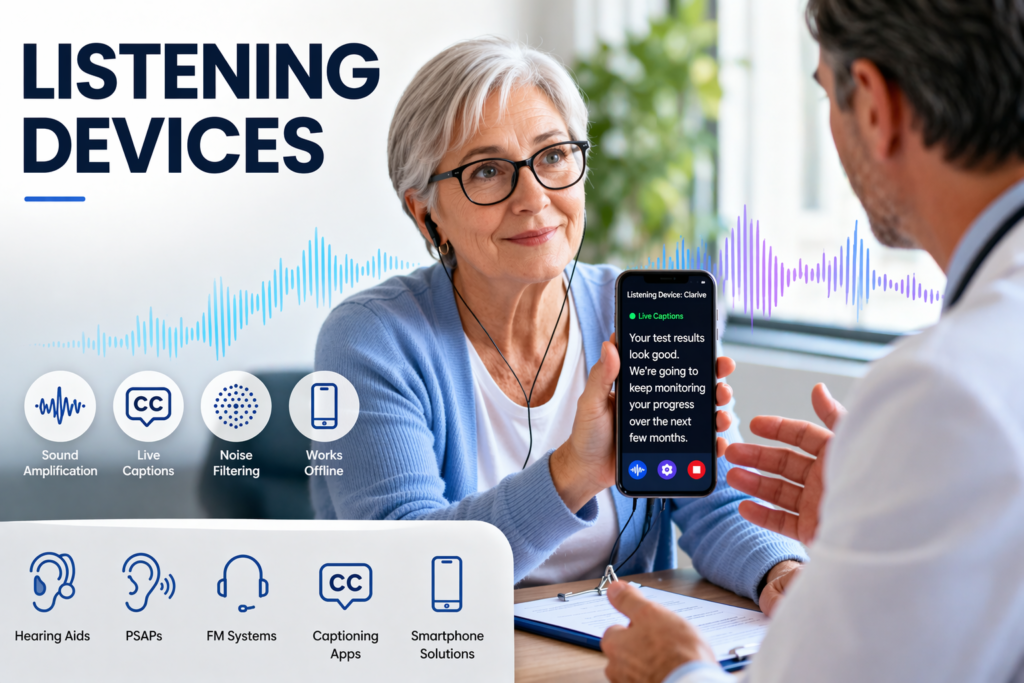
Listening Device: Clarive is one of the most complete options available. It turns your phone into a smart hearing assistant – amplifying voices, filtering background noise, and providing real-time live captions so you never miss a moment of a conversation.
Here is how it helps in real daily situations:
At a family dinner with background noise: Clarive’s voice amplifier cuts through the chatter and boosts the voices you want to hear. Just connect your earphones, point your phone toward the speaker, and the difference is immediate.
In a lecture or work meeting: Turn on Live Caption and watch every word appear on screen in real time – no internet required, no account setup, just instant on-screen transcription you can follow along with.
In a one-on-one conversation: Clarive amplifies voices in a quiet setting, making soft-spoken conversation partners much easier to follow – especially for people with high-frequency loss who miss certain consonants.
Clarive works with any wired or wireless audio device, requires no internet connection, and offers both its Hearing Aid and Live Caption features up to 5 times per day completely free – with pro plans starting at just $5.99/month (or $24.99/year, currently 50% off with a 7-day free trial).
For someone not yet ready to invest in a full hearing aid – or someone looking for a daily backup in situations where their hearing aid struggles – Clarive fills a genuine gap.
Communication Strategies and Rehabilitation
Technology is only part of the picture. Many people with hearing loss benefit significantly from:
- Auditory rehabilitation / aural rehab – Structured training to improve listening skills and communication strategies
- Lip reading / speech reading – Learning to supplement hearing with visual cues from faces and mouths
- Sign language – For those with profound loss, sign language (ASL, BSL, etc.) offers a rich, complete language system
- Hearing loops and captioned media – Making entertainment and public spaces more accessible
- Support groups – Connecting with others who understand the experience firsthand
Living Well with Hearing Loss: Practical Daily Strategies
A diagnosis of hearing loss does not mean the end of a rich social life. These small adjustments make an enormous difference:
In conversations:
- Tell people you have hearing loss – most will instinctively speak more clearly
- Position yourself to see the speaker’s face; lighting matters
- Reduce background noise when possible (turn off the TV, move to a quieter corner)
- Do not pretend to understand when you have not – it only leads to confusion later
At home:
- Use visual alerts (flashing lights) for doorbells and smoke alarms
- Enable captions on your TV and streaming services
- Use amplified or captioned telephone services
At work:
- Request accommodations – employers are legally required to make reasonable adjustments in most countries
- Ask for written summaries of meetings
- Use a sound amplification app in one-on-one settings
For mental health:
- Acknowledge that hearing loss fatigue is real – listening hard all day is exhausting
- Do not isolate; connection is protective
- Seek support if you notice signs of anxiety or depression; hearing loss significantly increases risk for both
Hearing Loss and Mental Health: The Connection Most People Miss
This is something too few guides mention.
Hearing loss does not just affect sound. It affects relationships, confidence, employment, and emotional wellbeing. Research consistently shows that untreated hearing loss is associated with:
- Higher rates of depression and anxiety
- Social withdrawal and isolation
- Accelerated cognitive decline – with some studies linking untreated hearing loss to a significantly increased risk of dementia
- Lower job performance and earnings
- Relationship strain – for both the person with hearing loss and their partners and family members
This is why early treatment matters so profoundly. It is not just about hearing better. It is about staying connected – to the people, the moments, and the life you want.
Conclusion: You Do Not Have to Miss Another Moment
Hearing loss is not a personal failing. It is not something to be embarrassed about or push through in silence.
Over a billion people live with it. The science of managing it has never been better. And the tools – from sophisticated hearing aids to live-caption apps on your phone – have never been more accessible.
The first step is simply deciding not to wait.
If you are experiencing signs of hearing loss, start with a hearing test. If you want something practical you can try today – right now –download Listening Device: Clarive and hear what you have been missing. It takes 30 seconds to set up, works without any internet connection, and gives you both sound amplification and live captions completely free to start.
Because every conversation matters. Every moment of connection matters. And you deserve to be fully present for all of them.
Listening Device: Clarive is available on iOS. Free access includes up to 5 uses of both Hearing Aid and Live Caption per day. Pro plans start at $5.99/month, with an annual plan at $24.99/year (currently 50% off) and a 7-day free trial.
Frequently Asked Questions
Can hearing loss be reversed?
It depends on the type. Conductive hearing loss caused by earwax, infection, or fluid can often be reversed with treatment. Sensorineural hearing loss – which involves damage to the hair cells or auditory nerve – is generally permanent, though it is highly manageable with the right tools.
At what age does hearing loss typically start?
Age-related hearing loss (presbycusis) typically begins after age 50 and becomes more noticeable through the 60s and 70s. However, noise-induced hearing loss can begin much earlier – even in teenagers and young adults exposed to loud music or work environments.
Is tinnitus the same as hearing loss?
Not exactly. Tinnitus is the perception of ringing, buzzing, or other sounds with no external source. It often coexists with hearing loss (particularly sensorineural), but it can also occur in people with normal hearing. It is a symptom, not a diagnosis in itself.
Can children use hearing amplification apps?
Smartphone-based amplification tools can be useful for older children and teens in specific situations, but they are not a substitute for proper audiological assessment and professionally fitted hearing aids for children with confirmed hearing loss. If you suspect your child has hearing loss, see a pediatric audiologist first.
Are over-the-counter hearing aids as good as prescription ones?
OTC hearing aids are a legitimate, affordable option for adults with mild to moderate sensorineural hearing loss. They are not suitable for severe or profound loss, or for children. They lack the customized fitting and programming that audiologist-prescribed devices offer, but for many people, they provide significant, meaningful help.
How do I know if I need a hearing aid or a sound amplification app?
For mild difficulty – especially in noisy situations – a sound amplification app like Listening Device: Clarive is a smart, low-barrier starting point. If you are struggling across multiple everyday situations, or if you have already had an audiological assessment confirming moderate or greater hearing loss, a professionally fitted hearing aid will provide more comprehensive support. The two are not mutually exclusive – many people use both.