You’re sitting across from your doctor. They’re explaining your diagnosis. You catch every third word – maybe.
That moment of panic? Millions of people with hearing loss live it every single day.
Listening devices exist to fix exactly that. But most guides on this topic focus on spies, journalists, and meeting recorders. Nobody talks about the people who actually need these tools most – those who are deaf, hard of hearing, or struggling to keep up in a noisy world.
This guide is different. It covers what listening devices really are, the types that exist, and how tools like Listening Device: Clarive are changing what accessibility looks like in 2025.
What Is a Listening Device?
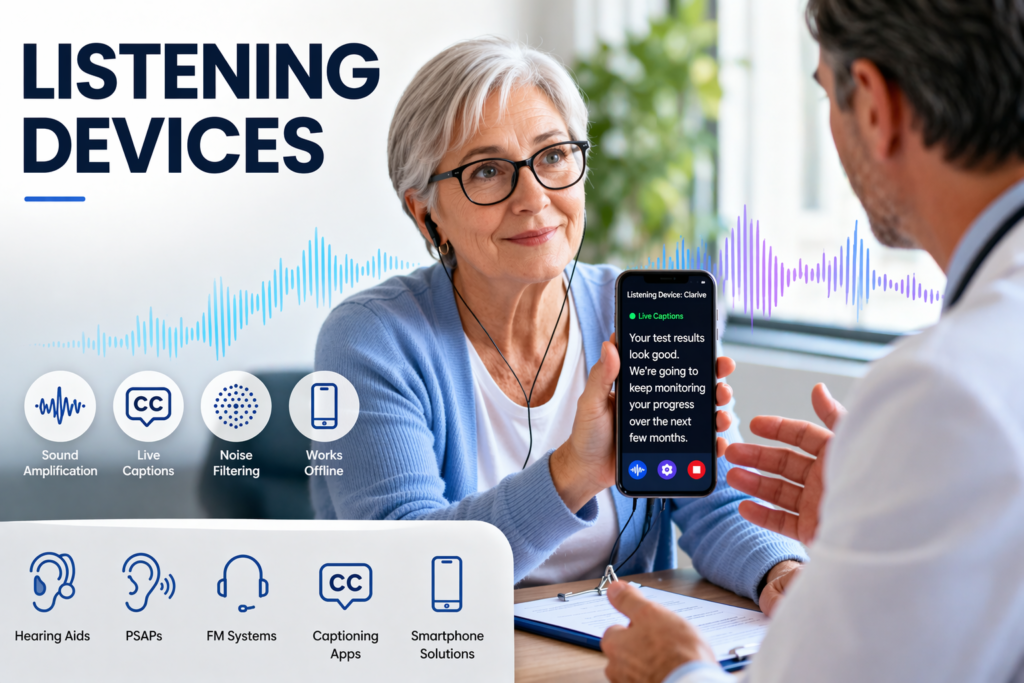
A listening device is any tool that helps you capture, amplify, or understand sound better.
That definition is broader than most people realize. It includes:
- Traditional hearing aids worn behind or inside the ear
- Sound amplifiers that boost voices and reduce background noise
- Live caption apps that convert speech to text in real time
- Personal sound amplification products (PSAPs) for everyday use
- FM/loop systems used in public spaces like theaters and classrooms
- Smartphone apps that turn your phone into a smart hearing assistant
The common thread? They all help bridge the gap between what’s being said and what you can hear.
If you’ve been exploring assistive technology for deaf and hard of hearing individuals, listening devices are one of the most important categories to understand.
Types of Listening Devices You Should Know
1. Hearing Aids
Hearing aids are the most recognized type. They sit in or behind your ear and use a microphone, amplifier, and speaker to boost sound.
They work best for people with diagnosed hearing loss. But they come with real barriers:
- They require a prescription and audiologist visit
- Average cost: $2,000–$7,000 per pair
- Not everyone qualifies, and not every situation calls for one
Hearing aids are powerful – but they’re not the only answer.
2. Personal Sound Amplification Products (PSAPs)
PSAPs are over-the-counter devices that amplify sound without a prescription. They’re designed for people who want better hearing in specific situations – a quiet restaurant, a family gathering, a church service.
They’re more affordable than hearing aids but less customizable for medical hearing loss.
3. FM Systems and Hearing Loops
These are assistive listening systems built into public spaces. They send audio directly to hearing aids or receivers, cutting out background noise.
You’ll find them in:
- Theaters and concert halls
- Airports and train stations
- Courtrooms and conference rooms
The downside? You’re dependent on the venue having the system installed.
4. Captioning and Transcription Tools
This is where technology has exploded in recent years. Live caption apps for deaf users convert spoken words into text on your screen – in real time.
No hearing aid required. No special hardware. Just your phone.
For many people, this is the most practical and affordable listening solution available today.
5. Smartphone-Based Listening Devices
Your phone can now act as a full hearing assistant. Apps like Listening Device: Clarive combine sound amplification, noise filtering, and live captions in one place – no account, no internet, no setup.
This category is growing fast, and for good reason. Smartphones are always with us. They’re familiar. And the technology has finally caught up to the need.
Who Actually Uses Listening Devices?
The answer might surprise you.
People who are hard of hearing – This is the obvious group. Over 1.5 billion people worldwide experience some degree of hearing loss. Many don’t wear hearing aids but still need help in specific situations.
People with age-related hearing loss – Presbycusis (gradual hearing loss from aging) affects roughly 1 in 3 people over 65. Many of them resist traditional hearing aids but are open to discreet, easy-to-use alternatives.
Deaf individuals navigating hearing environments – Someone who is fully deaf may not benefit from amplification but can use captioning tools to follow conversations without needing an interpreter. If you want to understand more about the spectrum of hearing identity, hard of hearing vs. deaf is worth reading.
Caregivers and family members – A caregiver supporting a deaf or hard of hearing person often uses these tools to communicate more effectively. Understanding how to communicate with a deaf person becomes much easier when both sides have access to the right tools.
People in noisy environments – Restaurants, construction sites, crowded transport – anyone can struggle to hear clearly in certain environments. Listening devices help here too.
What Makes a Good Listening Device in 2026?
Not all listening devices are equal. Here’s what separates a good one from a great one – especially for accessibility:
Real-time performance – There should be no noticeable lag. Whether you’re amplifying a voice or reading live captions, delay breaks the experience.
Background noise filtering – Amplifying everything equally is useless. A good device or app distinguishes voices from background noise and prioritizes speech.
Ease of use – Accessibility tools need to be accessible. If setup takes 20 minutes, that’s a design failure. The best tools work the moment you open them.
No dependency on the internet – In a quiet doctor’s office, a noisy subway, or a rural school, you don’t always have reliable Wi-Fi. Offline functionality is a genuine need, not a bonus feature.
Affordability – Hearing loss doesn’t discriminate by income. The best tools have free tiers that actually work.
How Listening Device: Clarive Works
Most hearing tools solve one problem. Clarive solves three at once.
Open the app, connect your earphones, and you immediately get:
Real-time sound amplification – Voices get louder and clearer. Background noise gets filtered out. You hear the conversation, not the room.
Live captions on screen – Every word spoken near you appears as text on your phone screen in real time. No internet required. No delay.
Voice amplifier controls – You control how much amplification you want. Quiet café? One setting. Busy train station? Another.
It works with any wired or wireless earphones – no special hardware to buy. No account to create. No data being collected or stored in the cloud.
For someone who needs support in a classroom, a family dinner, or a medical appointment, Clarive is the tool that’s actually there when you need it.
If you’re also exploring real-time speech to text options, Clarive fits naturally into that category while going further with amplification built in.
Real-World Situations Where Listening Devices Make a Difference
In the Classroom
A student with mild hearing loss sits in the back of a lecture hall. The professor talks fast. There’s HVAC noise, shuffling papers, side conversations.
A traditional hearing aid picks up everything – including the noise. A smartphone with Clarive amplifies the professor’s voice and shows captions on screen. The student stays up with every word.
At a Medical Appointment
Doctors speak quickly. Medical terms are hard to catch even with good hearing. Missing a word about medication dosage or a diagnosis can have real consequences.
With live captions running on your phone, every word is captured as text. You can even scroll back to review what was said.
During Family Conversations
Holiday dinners are notoriously hard for people with hearing loss. Everyone talks at once. Background noise is everywhere. And people get tired of repeating themselves – which is painful for everyone.
A discreet listening device running on your phone makes these moments easier without drawing attention.
In Public Spaces
Airports, train stations, shopping malls – announcements are made over poor-quality PA systems. Live captioning picks up the words your ears miss.
Listening Device vs. Hearing Aid: What’s the Difference?
| Feature | Traditional Hearing Aid | Listening Device: Clarive |
| Requires prescription | Yes | No |
| Average cost | $2,000–$7,000 | Free (Pro: $24.99/year) |
| Works offline | Yes | Yes |
| Live captions | No | Yes |
| Background noise filter | Varies | Yes |
| Setup time | Days/weeks | Seconds |
| Works with any earphones | No | Yes |
Hearing aids are medical devices. They’re irreplaceable for certain types and degrees of hearing loss. But for everyday support – and for people who aren’t ready for or can’t afford hearing aids – app-based listening devices fill a real gap.
The Bottom Line
Listening devices are not just for spies or journalists. They’re for the grandmother who can’t follow dinner conversation. The student who misses half the lecture. The professional in a noisy open office. The person sitting in a hospital room, trying to understand what the doctor just said.
The best listening device is the one you actually use – and that means it has to be simple, affordable, and always with you.
Listening Device: Clarive puts amplification, noise filtering, and live captions in the phone already in your pocket. No setup. No account. No barriers.
Try Clarive free today – and hear what you’ve been missing.
FAQs
What is a listening device for hearing?
A listening device for hearing is any tool – hardware or software – that helps a person hear more clearly. This includes hearing aids, amplifiers, live caption apps, and smartphone-based tools like Clarive.
Can I use a listening device without a hearing aid?
Yes. Apps like Listening Device: Clarive work entirely through your smartphone and earphones. No hearing aid or prescription is required.
Are listening devices free?
Many have free tiers. Clarive offers both its hearing amplifier and live caption feature up to 5 times per day completely free. The Pro plan starts at $24.99/year.
What’s the difference between a hearing aid and a sound amplifier?
Hearing aids are medical devices calibrated for specific types of hearing loss. Sound amplifiers boost all sounds and are designed for situational use – not medical treatment.
Do listening device apps work without the internet?
Clarive does. Both the amplification and live caption features work fully offline. This is important for situations where connectivity is limited.
Is a listening device useful for someone who is fully deaf?
Sound amplification won’t help someone with no residual hearing. But live captioning – converting speech to text in real time – is useful for deaf individuals navigating hearing environments.