You’re sitting in a crowded room. People are laughing, talking, and sharing stories. But you can’t make out a single word. Not because you aren’t paying attention – because the world around you wasn’t built for you to hear it.
This is the daily reality for millions of deaf and hard-of-hearing people in America. And it’s exactly why Deaf History Month exists.
Every year, this observance gives the world a chance to stop, learn, and celebrate a community that has fought hard for the right to be educated, respected, and heard. In this guide, you’ll learn everything you need to know – from when it happens and how it started, to key facts, famous figures, and simple ways to take part.
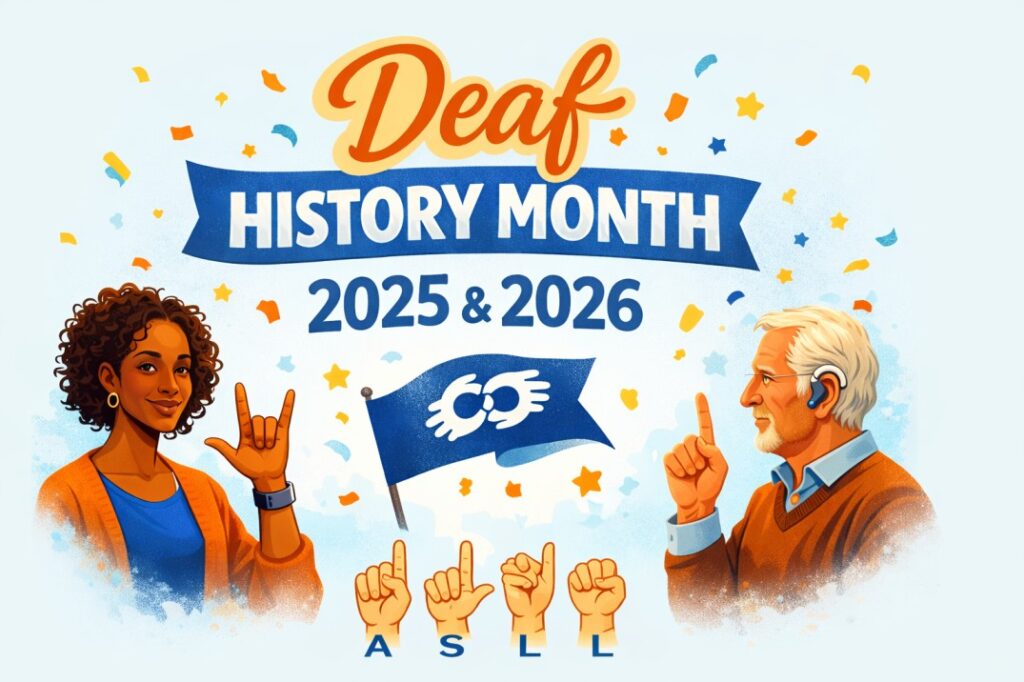
What Is Deaf History Month?
National Deaf History Month is a yearly observance in the United States dedicated to celebrating the history, culture, and achievements of deaf and hard-of-hearing people.
It is not just a look back at the past. It is a reminder of how much the Deaf community has contributed to American life – and how much further society still needs to go in terms of accessibility and inclusion.
During this month, communities across the country come together to:
- Honor key milestones in deaf education and advocacy
- Raise awareness about the daily challenges faced by deaf individuals
- Teach American Sign Language (ASL) and promote deaf culture
- Celebrate famous deaf figures whose stories often go untold
Libraries, schools, universities, and disability organizations all take part, making it one of the most widely recognized accessibility observances in the U.S.
When Is Deaf History Month 2025 and 2026?
Here is the simple answer: National Deaf History Month runs April 1–30.
The National Association of the Deaf (NAD) – the leading deaf rights organization in the United States – officially moved the observance to a full April calendar month in 2022. So whether you are searching for Deaf History Month 2025 or Deaf History Month 2026, the month is April both years.
That said, you will still find many schools and libraries observing the original dates of March 13 to April 15. Both date ranges connect to the same powerful history.
Here is a quick breakdown:
- Original observance: March 13 – April 15 (still used by many schools and libraries)
- Current official dates (NAD): April 1 – April 30
- Who uses April 1–30: NAD and affiliated deaf organizations nationwide
When someone asks when is national Deaf History Month – the official answer today is April, all month long.
When Did Deaf History Month Start?
Deaf History Month started in a library – and it began with one small, generous act.
In 1996, two deaf employees at the Martin Luther King Jr. Memorial Library in Washington, DC decided to mark a major anniversary in deaf history by teaching American Sign Language to their coworkers. That moment of sharing inspired the library’s management to organize a Deaf Awareness Week. The idea caught on quickly.
The National Association of the Deaf saw the potential and proposed turning it into a full month-long national observance. By 1997, the first official Deaf History Month was celebrated across the country.
What started with two people teaching sign language in a library grew into a nationwide movement – backed by the American Library Association, the NAD, and communities in every state.
What Are the 3 Dates of Deaf History Month?
The original March 13–April 15 window was chosen deliberately. Each date marks a moment that changed the course of deaf history in America forever.
March 13, 1988 – The Deaf President Now Movement
In early 1988, Gallaudet University needed a new president. Gallaudet is the world’s only university specifically designed for deaf and hard-of-hearing students, so this decision carried enormous weight.
The university’s board chose a hearing candidate – even though two deaf candidates were also in the running. Students were furious. They responded by:
- Chaining the university’s gates shut
- Staging organized marches and protests
- Demanding, loudly and clearly, that a deaf person lead a deaf university
This protest became known as the “Deaf President Now” movement. Within days, the board reversed its decision. On March 13, 1988, I. King Jordan was appointed as Gallaudet’s very first deaf president.
This moment was not just a victory for Gallaudet. It became a landmark event for deaf rights, disability rights, and civil rights across the entire country.
April 8, 1864 – Gallaudet University Is Founded
On April 8, 1864, President Abraham Lincoln signed the charter that officially established what would become Gallaudet University. At the time it was called the Columbia Institute for the Instruction of the Deaf, Dumb, and Blind. It was later renamed to honor Thomas Hopkins Gallaudet, one of the greatest champions of deaf education in American history.
Today, Gallaudet remains the only university in the world built from the ground up for deaf and hard-of-hearing students.
April 15, 1817 – America’s First School for the Deaf Opens
On April 15, 1817, the American School for the Deaf opened its doors in Hartford, Connecticut. It was founded by three visionaries:
- Thomas Hopkins Gallaudet – a hearing educator who championed deaf education
- Mason Cogswell – a physician whose deaf daughter inspired the school’s creation
- Laurent Clerc – a deaf teacher from France who brought formal sign language instruction to America
This school holds a remarkable distinction. It was not just the first school for the deaf in the United States – it was the first school in the entire Western Hemisphere dedicated to educating students with any disability. Teachers who trained there went on to found deaf education programs around the world.
Deaf History Month Facts Most People Have Never Heard
Helen Keller is probably the most famous deaf-blind person in history – but Deaf history goes far deeper than one name. Here are some facts worth knowing:
- Pierre Desloges became the first deaf person in the world to write a published book, in 1779.
- Leonardo da Vinci learned sign language from a deaf painter named Christoforo de Predis and reportedly included sign language gestures in some of his famous paintings.
- The phrase “sign language” appeared in writing for the first time in 1824.
- William Hoy, a deaf outfielder who played for the Chicago White Sox, is credited by many historians with influencing the hand signal system umpires still use in baseball today.
- Thomas Edison lost most of his hearing as a child – and went on to hold over 1,000 patents and change the world.
- Juliette “Daisy” Gordon Low, who had significant hearing loss, founded the Girl Scouts of America.
- The National Association of the Deaf was founded on August 25, 1880, making it one of the oldest disability rights organizations in the country.
Black Deaf History Month: The Story Within the Story
One of the most important reasons the NAD moved Deaf History Month to April 1–30 was inclusion – specifically, making room for Black and BIPOC deaf history.
The original March 13–April 15 dates centered heavily on Gallaudet University and the American School for the Deaf. But for much of their history, these institutions excluded or severely underserved Black deaf students. Black deaf Americans were often forced to attend separate, underfunded schools with fewer resources and less support.
The recognition of Black Deaf history within this month is not a small detail. It is a correction of the historical record. It acknowledges that:
- BIPOC deaf individuals faced double discrimination – both racial and hearing-related
- Black deaf communities built their own schools, churches, and cultural spaces despite systemic exclusion
- Their stories are a vital and often missing chapter of American deaf history
The NAD’s 2022 decision came directly from a delegate mandate to actively dismantle racism within the Deaf community. National Deaf History Month, in its current form, is meant to celebrate all deaf Americans – especially those whose contributions have been overlooked for far too long.
How to Celebrate Deaf History Month
You do not need to be deaf to take part. Here are practical, meaningful ways anyone can celebrate:
Learn some ASL. Even learning the alphabet or a few basic signs shows respect for the language and culture. Many libraries offer free ASL classes during April, and free video lessons are widely available online.
Read and share deaf stories. Pick up a book about I. King Jordan, Laurent Clerc, or another deaf figure. Share a fact about deaf history on social media with the hashtag DeafHistoryMonth. Small shares reach real people.
Support deaf creators and businesses. Follow deaf artists, educators, chefs, and content creators. Buy from deaf-owned brands. Engagement and support matter more than most people realize.
Attend a local event. Libraries, universities, and disability organizations often host film screenings, panel discussions, and ASL workshops throughout April. Search for Ohio Deaf History Month events or check what is happening in your local area.
Try accessibility technology. One of the most powerful things a hearing person can do is experience, even briefly, what accessibility tools feel like. Apps like Listening Device: Clarive let you amplify sound and read real-time live captions right from your phone – with no internet, no account, and no complicated setup required. It is a small window into why these tools are not just helpful for deaf individuals – they are life-changing.
Deaf History Month Activities for Schools and Communities
Teachers, librarians, and community organizers have a real opportunity to make this month meaningful. Here are activities that work for all ages:
- Host a short ASL lesson – even 15 minutes of learning the manual alphabet leaves a lasting impression
- Build a Deaf History Month timeline display featuring the three key dates and other milestones
- Start a book club with books featuring deaf protagonists or written by deaf authors
- Screen a film like CODA, Children of a Lesser God, or Sound of Metal and follow it with a group discussion
- Assign a Deaf History Month poster project where students research and illustrate a deaf figure they find inspiring
- Invite a guest speaker – a deaf community member or certified ASL interpreter can bring the history to life in ways no textbook can.
Hearing loss touches every stage of life, and the more you understand it, the better equipped you are to protect yourself and the people you care about. Explore our guides below to learn about the signs, causes, types, and real cost of untreated hearing loss – everything you need in one place.
| Signs of Hearing Loss You Might Be Ignoring | Click |
| What Is Mild Hearing Loss? Levels, Signs | Click |
| Listening Devices: What They Are, How They Work | Click |
| The Complete Guide to Hearing Loss: Types, Causes, & Solutions | Click |
| Noise-Induced Hearing Loss: Causes, Symptoms, Prevention | Click |
| Why Millennials and Gen Z Are Experiencing Hearing Loss Earlier | Click |
| The Hidden Cost of Untreated Hearing Loss | Click |
| How Hearing Loss Affects Your Mental Health | Click |
Why Deaf History Month Still Matters
About 15 percent of American adults report some degree of hearing loss. That is tens of millions of people navigating a world that was largely designed without them in mind.
Deaf History Month matters for three clear reasons.
First, representation changes lives. When a deaf child sees a deaf university president, a deaf baseball player, or a deaf inventor, the message is clear – you belong in this world, and you can lead it.
Second, history shapes what comes next. Understanding the Deaf community’s past helps build better laws, better technology, and better systems of support. Progress does not happen by accident.
Third, culture deserves celebration. ASL is a complete, rich language with its own grammar, poetry, and humor. Deaf culture has its own art, community values, and identity. It deserves the same recognition and respect as any other culture in America.
Technology is also playing a growing role in this story. Real-time captioning, sound amplification tools, and smart hearing assistants are removing barriers that once seemed permanent – making it possible for deaf and hard-of-hearing individuals to participate fully in classrooms, workplaces, and everyday conversations.
Conclusion
Deaf History Month is not just a date on a calendar. It is a celebration of a community that refused to be silent – one that built its own schools, led its own universities, and changed what it means to be heard in America.
Here is what to take away from this guide:
- When is Deaf History Month? April 1–30 officially; March 13–April 15 historically
- When did it start? 1996, first celebrated in 1997
- What are the 3 key dates? March 13, 1988 | April 8, 1864 | April 15, 1817
- How can you celebrate? Learn ASL, read deaf history, attend events, support deaf creators, and use accessible technology
This April, take one step – however small – toward understanding a community that has always had a lot to say.If you want to experience firsthand why hearing accessibility tools matter so deeply, download Listening Device: Clarive for free. Amplify sound, read live captions, and get real-time support – right from your phone, wherever you are.
FAQs
What is Deaf History Month?
Deaf History Month is a U.S. annual observance that celebrates the achievements, culture, and history of deaf and hard-of-hearing people. It promotes awareness and honors milestones in deaf education and civil rights.
When is Deaf History Month 2025?
Deaf History Month 2025 runs April 1–30, as officially set by the National Association of the Deaf in 2022. Some schools and libraries still observe the original March 13–April 15 dates.
When is Deaf History Month 2026?
National Deaf History Month 2026 also runs April 1–30. The NAD moved it to a full April observance to create a more inclusive celebration of all deaf and hard-of-hearing Americans.
What are the 3 dates of Deaf History Month?
The three dates are March 13, 1988 when I. King Jordan became Gallaudet’s first deaf president, April 8, 1864 when Gallaudet University was founded, and April 15, 1817 when the American School for the Deaf opened.
When did Deaf History Month start?
Deaf History Month began in 1996 when two deaf library employees in Washington, DC taught ASL to coworkers. The first full national observance was celebrated in 1997 with NAD support.
What is National Deaf History Month?
National Deaf History Month is the official observance running April 1–30, recognized by the NAD. It honors all deaf Americans, with a growing emphasis on celebrating BIPOC deaf history and contributions.
How do you celebrate Deaf History Month?
You can celebrate by learning basic ASL, reading books about deaf figures, attending local events, supporting deaf-owned businesses, and using accessible technology like live captioning or sound amplification apps.
What is Black Deaf History Month?
Black Deaf History Month recognizes the history of BIPOC deaf individuals who faced racial and hearing-related discrimination. It is a key reason the NAD officially updated Deaf History Month dates in 2022.
What are some facts about Deaf History Month?
Deaf History Month started in a Washington, DC library in 1996. Pierre Desloges wrote the world’s first book by a deaf person in 1779. The NAD, founded in 1880, is one of America’s oldest disability rights organizations.
What is the Deaf History Month 2025 theme?
The official 2025 theme focuses on inclusivity and celebrating the full diversity of the Deaf community, including BIPOC deaf history – continuing the NAD’s commitment to recognizing all voices within deaf culture.
What is the Deaf History Month 2026 theme?
Deaf History Month 2026 honors Deaf history, culture, and language while celebrating 75 years of the World Federation of the Deaf and advocating for continued accessibility worldwide.