You are in a conversation, nodding along – but you only caught half of what was said. You turned up the TV again last night. Your friend had to repeat herself twice at dinner. You told yourself it was just background noise.
But what if it is not?
Hearing loss does not arrive all at once. It creeps in quietly – pun intended. Most people wait seven to ten years before they do anything about it. By that time, it has already affected their relationships, confidence, and daily life in ways they did not even notice.
This guide will help you spot the early signs of hearing loss before it gets worse. No jargon. No scare tactics. Just clear answers – and practical steps you can take today.
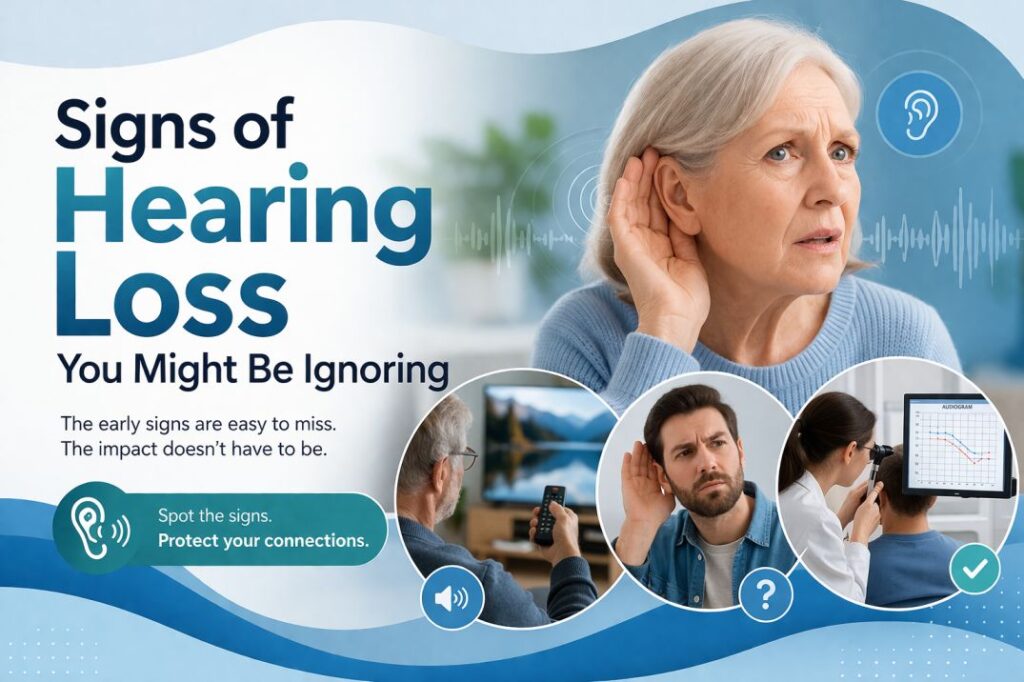
Why Hearing Loss Often Goes Unnoticed
Here is the difficult truth: hearing loss is one of the easiest conditions to ignore because it happens gradually. Unlike a broken arm or sudden illness, it does not announce itself.
Your brain is incredibly good at filling in the gaps. When it stops receiving clear sound signals, it compensates. I guess. It lip-reads without you realising. Over time, this becomes your new normal – until it is not manageable anymore.
This is why the warning signs of hearing loss are so easy to dismiss:
- “The room was just too loud.”
- “They were mumbling.”
- “I was distracted.”
Sound familiar? Let us look at what is actually happening.
Early Signs of Hearing Loss You Should Know
You Ask People to Repeat Themselves Often
This is one of the most common and most ignored early signs. If you find yourself regularly saying “Sorry, what?” or “Can you say that again?” – especially in quiet rooms – your hearing may be the reason, not the speaker.
Sounds Feel Muffled or Distant
One of the clearest symptoms of hearing loss is the sensation that sounds are coming through a wall or underwater. Voices sound blurry. Words lose their sharpness. You can hear that someone is speaking but cannot quite make out what they are saying.
This is what conductive hearing loss often feels like in the early stages. It can also be caused by earwax buildup, ear infections, or fluid behind the eardrum.
You Struggle in Noisy Environments
Noisy restaurants, busy offices, or group conversations – these become exhausting when your hearing is declining. Background noise makes it significantly harder to separate what matters from what does not.
If you find yourself avoiding social situations because it is too difficult to follow conversations, this is a major sign you should not ignore.
Ringing or Buzzing in the Ears (Tinnitus)
One of the signs of tinnitus in the ear is a persistent ringing, buzzing, hissing, or humming that no one else can hear. It might come and go, or it might be constant.
Tinnitus is often an early indicator of hearing damage. It is your auditory system signalling that something has changed. It does not always mean permanent hearing loss, but it should always be taken seriously.
You Turn Up the Volume Without Realising It
Your family keeps turning the TV back down. Your phone volume is always at maximum. You only notice the problem when someone else points it out.
This is one of the most overlooked signs of going deaf, precisely because it feels so gradual. Each day you turn it up just a little more – until it becomes the new normal.
Missing High-Pitched Sounds
High-pitched sounds go first in most cases. This includes:
- Birdsong
- The doorbell or a ringing phone from another room
- Children’s voices
- The letter sounds “s,” “f,” and “th” in speech
High-pitched hearing loss is common in adults and is often linked to noise exposure over time or the natural ageing process (known as presbycusis, which is sensorineural in nature).
Trouble Following Conversations on the Phone
Phone calls strip away the visual cues – lip reading, facial expressions, body language – that you may have been unconsciously relying on. If phone conversations have become particularly difficult while in-person ones feel manageable, your hearing may already be compensating through visual information.
Signs of Hearing Loss in Adults vs. Children
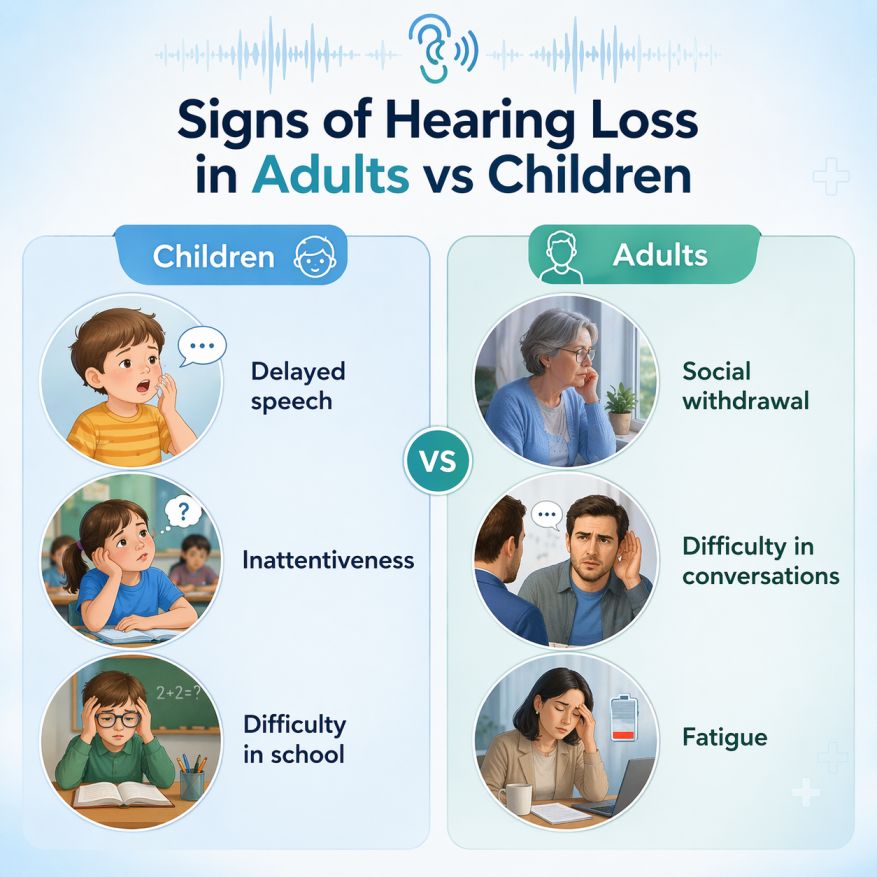
The signs of hearing loss in children are different from those in adults. Children may:
- Fail to respond when called by name
- Seem inattentive or “in their own world”
- Show delayed speech development
- Speak louder than necessary
- Struggle at school without a clear academic reason
In adults, symptoms of hearing loss tend to look more like social withdrawal, fatigue after conversations, and difficulty in group settings.
If you are asking “am I hard of hearing?” and ticking multiple boxes from the adult list – or noticing signs of hearing loss in babies or young children around you – early action makes all the difference.
Warning Signs You Are Losing Your Hearing Fast
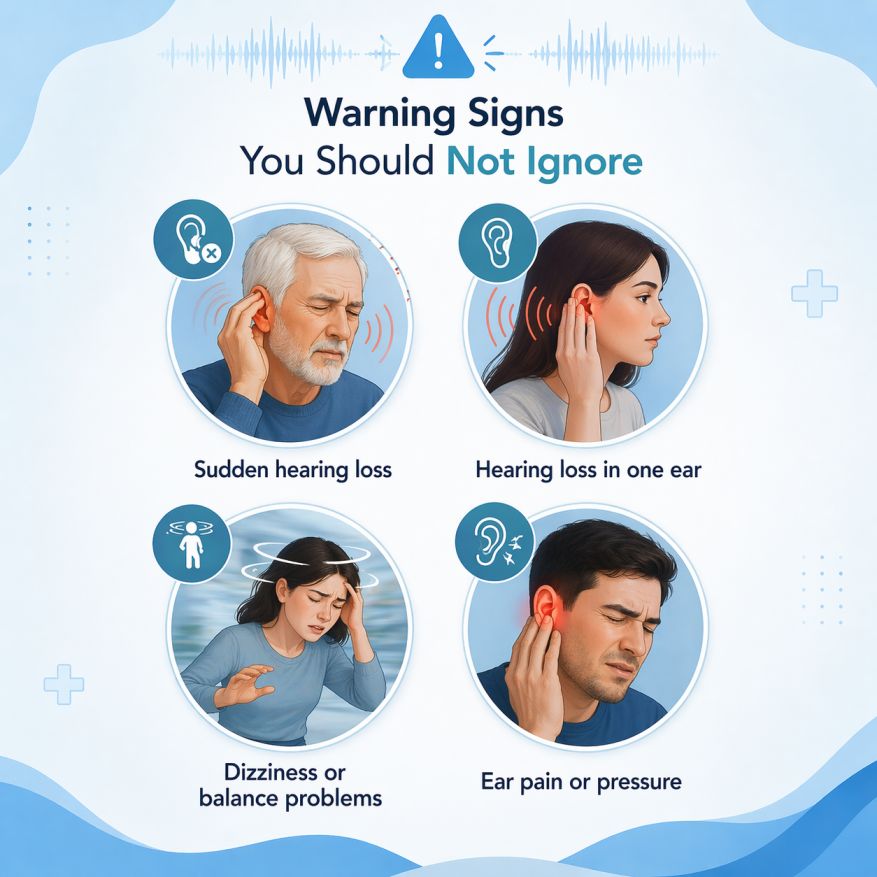
Some signs suggest your hearing is changing more rapidly. Pay close attention if you experience:
- Hearing going in and out unpredictably
- Sudden muffled hearing in one ear after a loud noise
- Hearing loss in one ear only (sign of hearing loss in one ear)
- Dizziness or balance problems alongside hearing changes
- Ear pressure or pain with reduced hearing
These can indicate sudden sensorineural hearing loss, which is a medical emergency. If this happens, see a doctor within 48 to 72 hours. Early treatment significantly improves outcomes.
Ototoxicity – hearing damage caused by certain medications – can also cause rapid decline. If you recently started a new medication and noticed changes, mention it to your doctor.
Common Causes of Hearing Loss
Understanding what causes hearing loss helps you protect what you have left. The most common reasons someone might experience hearing loss include:
- Age-related changes – Presbycusis is natural, gradual, and sensorineural
- Noise exposure – Concerts, machinery, headphones, and earbuds (yes, AirPods can contribute to hearing damage over time with high volume use)
- Earwax buildup – Earwax can cause muffled hearing and even temporary deafness if left untreated
- Ear infections – Fluid and inflammation affect how sound travels
- Head trauma – Can damage the inner ear or auditory nerve
- Illness – Pneumonia can cause hearing loss in some cases, as can certain viral infections
- Genetics – Family history plays a significant role
- Ototoxic medications – Certain antibiotics, chemotherapy drugs, and diuretics
Can earwax cause deafness? In severe cases of impaction, yes – temporarily. The good news is this is fully reversible with the right treatment.
How to Know If Your Hearing Loss Is Permanent
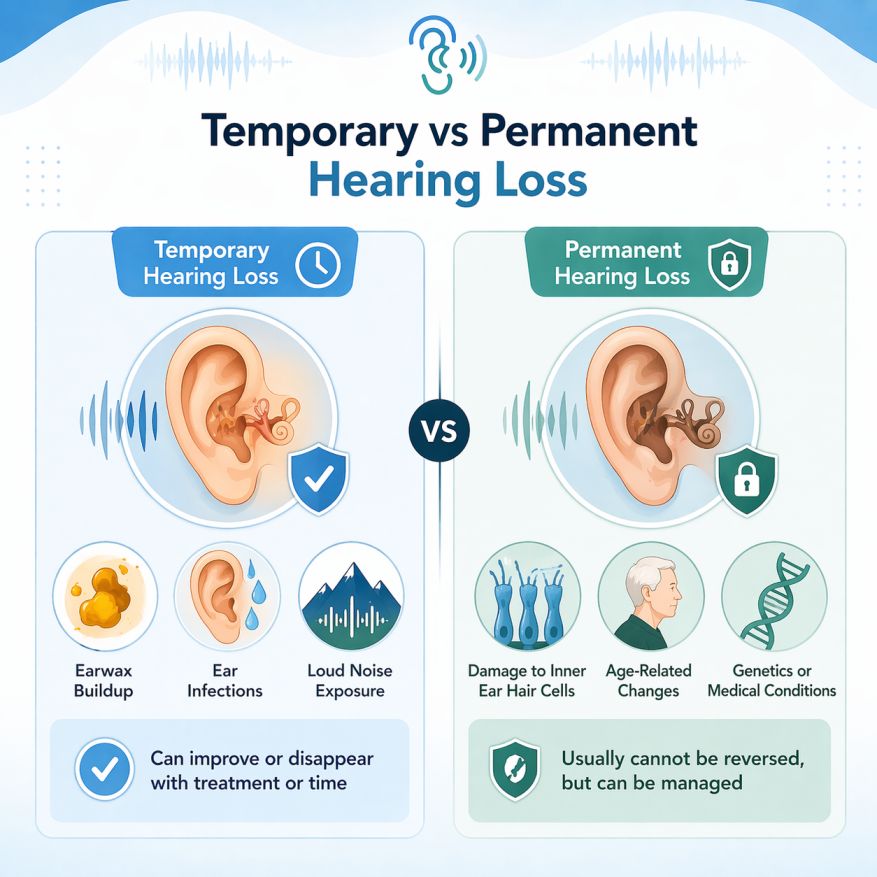
This is one of the most searched questions – and understandably so. Hearing loss can be temporary or permanent depending on its cause.
Temporary hearing loss is usually caused by:
- Earwax blockage
- Ear infections
- Fluid in the middle ear
- Short-term noise exposure (like a concert)
Permanent hearing loss is more likely when:
- The auditory nerve or hair cells in the inner ear are damaged
- There is long-term noise exposure without protection
- The loss has been present and untreated for years
- It is linked to ageing (presbycusis)
The only way to know for certain is through a proper audiometry test – also called an audiogram – conducted by an audiologist. A basic hearing test at a clinic will map your hearing across different frequencies and tell you exactly where your hearing loss sits and how significant it is.
When Should You Get a Hearing Test?
You should get your hearing tested if:
- You recognise three or more of the signs above
- Friends or family have pointed out your hearing issues
- You are over 60 (annual checks are recommended)
- You work in a noisy environment
- You have experienced a sudden change in hearing
- You are struggling at work or in social situations because of sound
Many people ask “how much does a hearing test cost without insurance?”
The answer varies, but many clinics offer a basic hearing test for free or at low cost as an initial screen. There are also at-home hearing tests available online to get a general sense of your hearing.
Do not wait until the hearing problems feel unbearable. Early detection leads to better outcomes.
What You Can Do Right Now – Without a Clinic
While a proper diagnosis requires a professional, there are real steps you can take today to support your hearing – and your daily life.
This is where tools like Listening Device: Clarive become genuinely useful.
Imagine you are at a family dinner and struggling to follow the conversation. You are tired of asking people to repeat themselves. You do not want to miss the punchline again. You open Clarive on your phone, plug in your earphones, and within seconds – voices are amplified, background noise is filtered, and live captions appear on screen so you can read along in real time.
No internet needed. No account. No setup.
Listening Device: Clarive is designed for people who are hard of hearing, those with mild hearing loss or hearing impairment, and anyone who simply wants clearer, louder, more comfortable sound in their daily life. Whether you are in a noisy classroom, a quiet one-on-one conversation, or a crowded waiting room – it gives you real-time support, right when you need it.
Key features that help:
- Real-time sound amplification – hear voices more clearly wherever you are
- Live Caption for on-screen transcription – read what people are saying as they speak
- Voice amplifier controls – adjust sound to your comfort
- Works with any wired or wireless earphone
- No internet or account required
You can use both the Hearing Aid and Live Caption features up to five times per day completely free. For unlimited access, the Pro plan starts at just $5.99/month – or $24.99/year (currently 50% off) with a 7-day free trial.
It is not a replacement for professional care. But it is a practical, immediate way to improve your daily hearing experience while you figure out your next steps.
Conclusion
Hearing loss does not ask for your attention. It slips in quietly, disguised as noisy rooms and mumbling people. But the signs are there if you know what to look for.
- Muffled sounds
- Asking people to repeat themselves
- Ringing in the ears
- Turning up the volume again and again
- Struggling in noisy environments
These are not small inconveniences. They are your ears asking for help.
Start by acknowledging what you are experiencing. Then take action – whether that is booking a hearing test, speaking to your doctor, or using a tool like Clarive to make today a little easier to navigate.
Your hearing matters. And so does every conversation you do not want to miss.
Frequently Asked Questions
What are the first signs of hearing loss in adults?
The earliest signs include frequently asking people to repeat themselves, sounds feeling muffled, trouble following conversations in noise, and turning up the TV volume more than usual without realising it.
How do I know if I have hearing loss or just bad hearing days?
If the issue is consistent – not tied to a cold or earwax – and you notice multiple warning signs regularly, it is worth getting a professional hearing test to check your baseline.
Can hearing loss happen in one ear only?
Yes. Single-sided hearing loss is common and can result from ear infections, noise trauma, or nerve damage. It often presents as difficulty locating sounds or struggling on phone calls.
What does hearing loss sound like?
Voices may sound muffled, distant, or garbled. High-pitched sounds like “s” and “f” become harder to hear. It can feel like listening through a wall or with earplugs in.
How to tell if you are going deaf in one ear?
Signs include struggling to understand speech on one side, sound seeming to come from one direction, difficulty on phone calls, and one ear feeling full, blocked, or pressured.
Can earwax cause deafness or hearing loss?
Yes. Severe earwax impaction can temporarily block the ear canal and cause muffled hearing. It is fully reversible with safe removal by a healthcare professional.
What causes sudden hearing loss?
Sudden sensorineural hearing loss can be caused by viral infection, reduced blood flow, or trauma. It is a medical emergency requiring treatment within 48 to 72 hours for the best recovery.
Is presbycusis the same as sensorineural hearing loss?
Yes. Presbycusis is age-related hearing loss and is sensorineural in nature, meaning it involves changes in the inner ear or auditory nerve – not the outer or middle ear.
Can airpods or earbuds cause hearing loss?
Yes, prolonged use at high volumes can damage the hair cells in the inner ear over time. Experts recommend keeping volume below 60% and limiting listening sessions to 60 minutes at a stretch.
When should I get my hearing tested?
You should get tested if you notice consistent hearing difficulty, are over 60, work in a loud environment, or experience sudden changes in hearing. Many clinics offer free initial screenings.