You turn up the TV a little louder. You ask people to repeat themselves more often. You nod along in conversations you can’t fully follow. It feels manageable. Just a minor inconvenience.
But what if your hearing loss is quietly costing you far more than you realize?
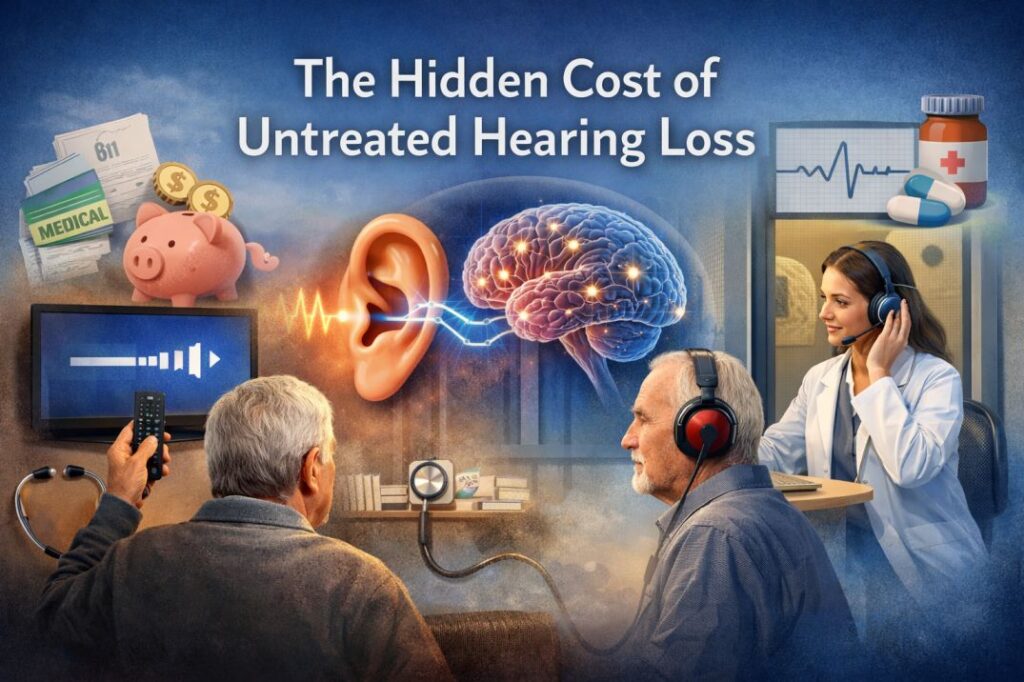
Research from Johns Hopkins, the JAMA Otolaryngology journal, and the Better Hearing Institute tells a different story. Untreated hearing loss is connected to dementia, depression, dangerous falls, higher medical bills, and thousands of dollars in lost income every single year.
This article breaks down exactly what the science says – and what you can do about it today.
What Does Research Show About Hearing Loss?
Most people think of hearing loss as an ear problem. But researchers have spent years tracing its effects across the entire body and brain – and the findings are hard to ignore.
Here are some of the most important facts about hearing loss that rarely make it into everyday conversation:
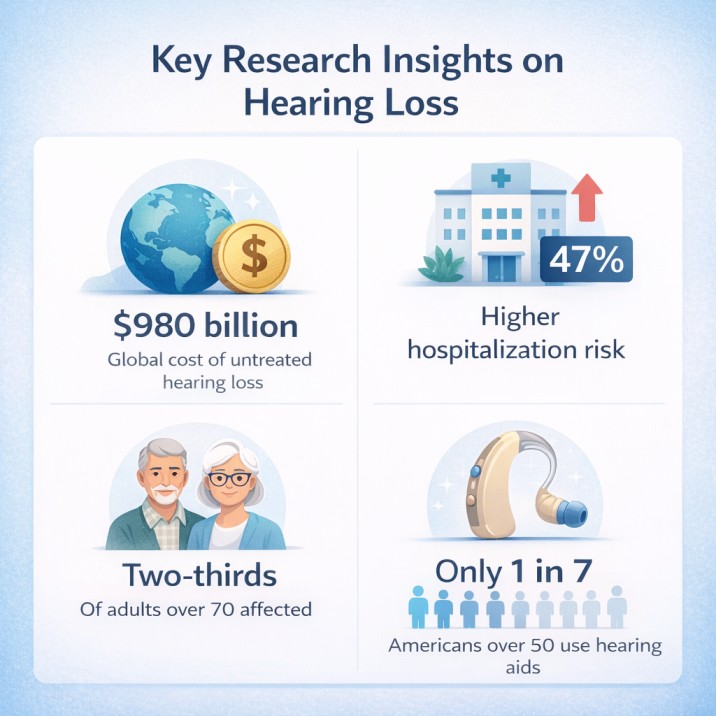
- Nearly two-thirds of adults over 70 have some degree of hearing loss
- Only 1 in 7 Americans over 50 who could benefit from a hearing aid actually uses one
- The global annual cost of untreated hearing loss is estimated at $980 billion, according to the World Health Organization
- People with hearing loss have a 47% increased rate of hospitalization over 10 years
Hearing loss is not just about sound. It affects how your brain works, how you connect with people, and how your body holds up over time.
The Hidden Link Between Hearing Loss and Dementia
This is the connection that surprises people the most – and the one backed by the strongest evidence.
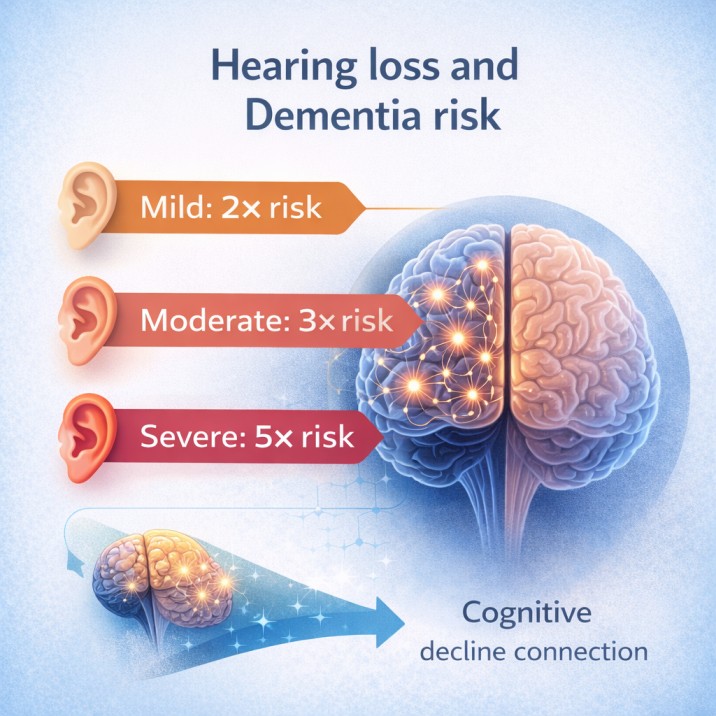
In a landmark 12-year Johns Hopkins study tracking 639 adults, researchers found a clear pattern between hearing loss severity and dementia risk:
- Mild hearing loss doubled the risk of dementia
- Moderate hearing loss tripled the risk
- Severe hearing impairment made a person five times more likely to develop dementia
A 2023 Johns Hopkins Bloomberg School of Public Health study added to this picture. It found that adults with moderate to severe hearing loss had a 61% higher prevalence of dementia compared to those with normal hearing. Hearing aid users in that group showed a 32% lower prevalence of dementia – a meaningful difference.
For a complete understanding of mild hearing loss, including its early signs, causes, and treatment options, read this detailed guide:Mild Hearing Loss
Why Does Hearing Loss Cause Dementia?
Researchers point to three mechanisms:
1. Cognitive load. When you can’t hear clearly, your brain works overtime to fill in the gaps. That constant strain pulls mental resources away from memory and thinking.
2. Brain atrophy. Brain scans show that hearing loss is associated with a faster rate of brain shrinkage. Less auditory input means less stimulation – and the brain responds by shrinking in the areas responsible for processing sound.
3. Social isolation. People with hearing loss often withdraw from conversations and social settings. That isolation cuts off the cognitive stimulation the brain needs to stay sharp. Social withdrawal is your brain losing one of its most important forms of exercise.
The 2020 Lancet Commission on Dementia identified untreated hearing loss as the single largest modifiable risk factor for dementia – bigger than physical inactivity, smoking, or high blood pressure.
How Hearing Loss Affects Your Brain Beyond Dementia
The cognitive hearing loss connection goes wider than dementia alone.
Adults with untreated hearing difficulty consistently report:
- Trouble following conversations, especially in noisy rooms
- Difficulty remembering what was just said
- Slower processing when switching between tasks
- Reduced ability to concentrate over long periods
This is sometimes called auditory deprivation – when the brain is starved of sound input for long enough, it begins to lose the neural pathways that process it. The longer hearing loss goes untreated, the harder it becomes to restore full clarity even with hearing aids.
Research published in JAMA found that hearing aids slowed cognitive decline by 48% over three years in the ACHIEVE study. That’s not a minor benefit. That’s nearly halving the speed at which the brain ages.
For a deeper understanding of how hearing loss is affecting younger generations, read this detailed guide: Hearing Loss in Millennials and Gen Z .
Impact of Untreated hearing loss
The psychological effects of hearing loss often begin quietly and grow over time.
Imagine being at a family dinner. The background noise, the overlapping conversations, the jokes flying across the table – it becomes overwhelming. You start declining invitations. The effort isn’t worth it anymore.
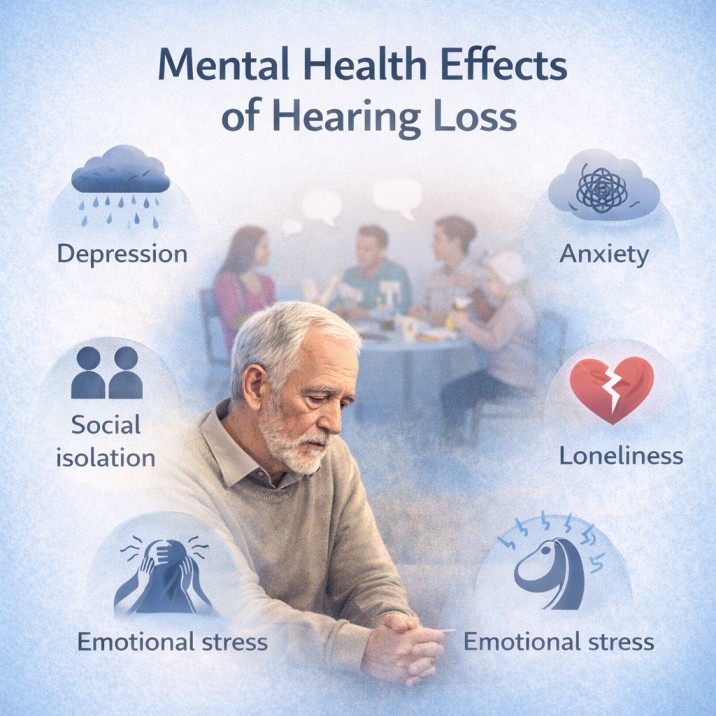
That gradual withdrawal leads somewhere darker.
- Adults with hearing loss are almost twice as likely to suffer from depression compared to those without hearing impairment, according to the National Institute on Deafness and Other Communication Disorders (NIDCD)
- 33% of adults 70 and older with hearing loss that affects daily communication report feelings of social isolation
- Social isolation and loneliness in older adults are linked to cardiovascular disease, cognitive decline, poor sleep, and even shorter lifespans
- Lack of social contact among older adults is associated with $6.7 billion in additional Medicare spending annually
The emotional cost of hearing loss is real, and it compounds. Difficulty hearing leads to embarrassment. Embarrassment leads to withdrawal. Withdrawal leads to loneliness. Loneliness accelerates everything else on this list.
Hearing Loss and Balance: The Fall Risk Nobody Talks About
Your ears do more than hear – they also help you stay upright.
As you walk, your inner ear picks up subtle cues about your balance and spatial position. When hearing is impaired, those signals are weakened. And your brain – already working harder to process sound – has less capacity left over for coordinating safe movement.
Johns Hopkins researchers found that even mild hearing loss triples the risk of accidental falls. For older adults, a fall is often far more serious than a bruise. It can mean a broken hip, a hospital stay, or a long recovery that changes the entire shape of a person’s daily life.
This is one of the most underappreciated dangers of untreated hearing loss – and one of the strongest arguments for treating it early.
The Financial Cost: Higher Medical Bills, Lower Income
Untreated hearing loss is expensive. Not just in hearing aids and doctor visits – but in ways that quietly drain finances over years.
Higher Healthcare Costs
A major 2016 study published in JAMA Otolaryngology – Head & Neck Surgery examined over 562,000 adults aged 55 to 64. The findings were stark:
- Those with untreated hearing loss spent $14,165 on healthcare over 18 months
- Those without hearing loss spent $10,629 over the same period
- That’s a 33% higher cost – for a group mostly covered by private, low-deductible insurance
Over a 10-year period, adults with untreated hearing loss face roughly 46% more in total healthcare costs, amounting to approximately $22,434 per person more than their peers.
Why? Researchers suggest that communication difficulties cause people to avoid timely medical care. They delay appointments because talking to doctors is stressful when you can’t hear well. Problems get worse. By the time they seek care, they’re sicker – and treatment costs more.
There’s also the medication safety problem. Mishearing instructions from a doctor or pharmacist can lead to taking the wrong dose, at the wrong time, in the wrong way. The compounding effects of medication errors are costly – and dangerous.
Lost Income at Work
Hearing loss doesn’t stay at home. It follows you to work.
- A study by the Better Hearing Institute found that untreated hearing loss can lead to up to $30,000 per year in lost income
- People with hearing loss have 1.98 times higher odds of being unemployed or underemployed compared to those with normal hearing
- Hearing loss creates 1.58 times higher odds of living on a low income
In meetings, missed words mean missed context. Instructions misheard on the job floor can mean mistakes. In a world where communication is currency, untreated hearing difficulty is a tax on your earning potential – one that’s invisible to most employers, who may interpret your silence as lack of interest or competence.
The Mortality Connection
Perhaps the most sobering finding of all.
A Johns Hopkins study found that adults over 70 with moderate to severe hearing loss had a 54% higher risk of death compared to those without hearing loss.
This doesn’t mean hearing loss directly causes early death. But the cascade of effects – social isolation, cognitive decline, depression, falls, delayed medical care – collectively takes a serious toll on the body over time.
Only 1 in 7 People Get Help. Why?
Given all of this evidence, it’s striking that so few people address their hearing loss.
Federal estimates suggest only 20% of those who could benefit from a hearing aid actually use one. In the JAMA study, just 13% of participants with diagnosed hearing loss had received any hearing services.
Common reasons people delay:
- Stigma – “Wearing hearing aids means I’m old”
- Cost – Hearing aids average around $1,675 per ear, and most insurance plans don’t cover them
- Denial – “It’s not that bad yet”
- Access – Audiologists are concentrated in urban areas; rural communities often go underserved
The average person with hearing loss waits 10 years before getting help. A decade of auditory deprivation. A decade of the brain compensating, straining, and gradually pulling back from the world.
What You Can Do Right Now
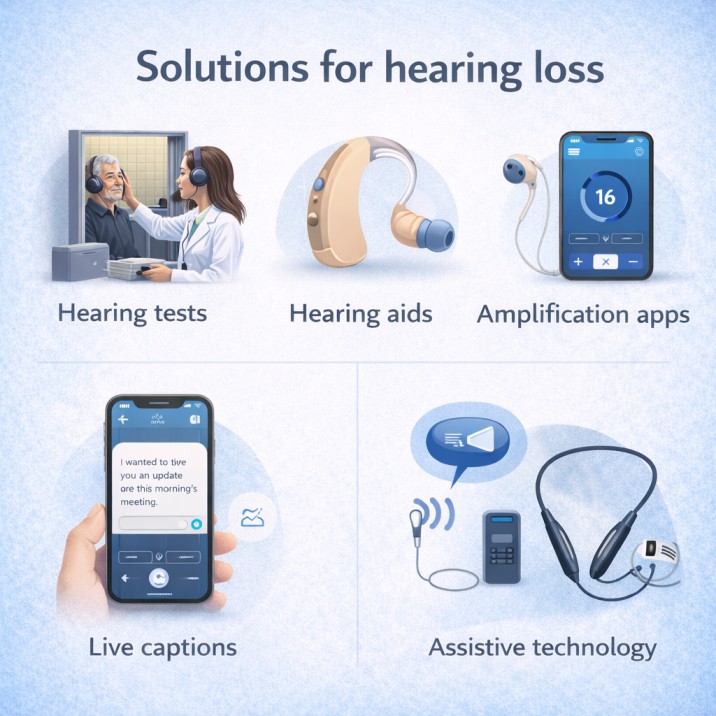
Addressing hearing loss doesn’t have to be complicated or expensive to start.
- Get a hearing test. Early signs of hearing loss are easier to manage when caught early. If you feel like your hearing is getting worse, don’t wait.
- Talk to your doctor about hearing aids. Even mild hearing loss can benefit from assisted hearing. Modern devices are small, wireless, and far more discreet than the image most people carry.
- Use hearing amplification apps. For those who aren’t ready for hearing aids, or need support between appointments, smartphone tools can help amplify voices and reduce background noise in real time.
This is where Listening Device: Clarive comes in. If you or someone you care for is hard of hearing and wants immediate, everyday support, Clarive turns your phone into a smart hearing assistant. Just plug in your earphones and it amplifies voices, filters background noise, and provides live captions – no internet connection, no account, no complicated setup required.
Whether you’re in a quiet conversation or a noisy room, Clarive gives you real-time support right when you need it. Both the Hearing Aid and Live Caption features are free to try up to 5 times per day.
Conclusion: The Cost of Doing Nothing Is Higher Than You Think
Hearing loss is easy to minimize. It creeps in gradually, and we find ways to work around it – until the workarounds stop being enough.
But the research is clear. Untreated hearing loss is linked to:
- A dramatically increased risk of dementia and cognitive decline
- Higher rates of depression and social isolation
- Triple the risk of dangerous falls
- Thousands of dollars in extra healthcare costs
- Up to $30,000 per year in lost income
- A 54% higher risk of early death in older adults
The good news: these risks are not inevitable. Treating hearing loss early – whether through hearing aids, assistive technology, or tools like Clarive – can slow cognitive decline, reduce isolation, and restore the quality of daily life.
Don’t wait 10 years. The hearing you protect today is the brain health, independence, and connection you keep tomorrow.
Read more-The Complete Guide to Hearing Loss: Types, Causes, and Modern Solutions
FAQ: Your Questions About Hearing Loss
Does hearing loss cause dementia?
Research shows it’s a significant risk factor. Mild hearing loss can double dementia risk, moderate loss triples it, and severe impairment increases the risk fivefold, according to a 12-year Johns Hopkins study.
What are the side effects of untreated hearing loss?
Untreated hearing loss is linked to dementia, depression, social isolation, falls, higher medical costs, lost income, and in older adults, a higher risk of early death.
Can hearing loss lead to dementia?
Yes – it’s one of the strongest modifiable risk factors. Hearing loss increases cognitive load, accelerates brain atrophy, and promotes social withdrawal, all of which are connected to dementia development.
How does hearing loss affect memory?
When the brain works harder to process unclear sound, fewer resources remain for memory and thinking. Over time, untreated auditory deprivation can accelerate cognitive decline and memory problems.
Is hearing loss linked to depression?
Strongly. Adults with hearing loss are almost twice as likely to experience depression, largely due to the social isolation and communication difficulties that come with untreated hearing difficulty.
Does hearing loss affect balance?
Yes. The inner ear plays a key role in balance. Even mild hearing loss is associated with triple the risk of accidental falls, according to Johns Hopkins researchers.
How much income can hearing loss cost you?
Studies by the Better Hearing Institute estimate that untreated hearing loss can result in up to $30,000 per year in lost income, due to reduced job performance and missed career opportunities.
Do hearing aids reduce the risk of dementia?
Evidence is promising. A 2023 Johns Hopkins study found hearing aid users had 32% lower dementia prevalence, and the ACHIEVE study showed hearing aids slowed cognitive decline by 48% over three years.
What is auditory deprivation?
Auditory deprivation occurs when the brain is deprived of sound input for extended periods. It can cause the brain to lose the neural pathways needed to process sound clearly, making hearing harder to restore over time.
When should I get a hearing test?
If you feel like your hearing is getting worse, ask people to repeat themselves often, or struggle in noisy environments, see a hearing professional soon. Early intervention produces far better outcomes than waiting years.