You turn the TV up a little louder. You ask someone to repeat themselves – again. You blame bad acoustics at the restaurant instead of your hearing.
Sound familiar?
Most people with mild hearing loss don’t think they have a problem. They think everyone struggles to hear in noisy rooms. They think it’s just tiredness, or that other people are mumbling more than usual.
But here’s the truth: mild hearing loss is real, it’s common, and it quietly affects your daily life long before it feels “bad enough” to do something about. On average, people wait 7 to 10 years after noticing early signs before they ever seek help – and that delay has consequences.
This article breaks down what mild hearing loss actually is, how it compares across the stages of hearing loss, what symptoms to watch for, and what you can do about it today.
What Is Normal Hearing in Decibels?
Before understanding hearing loss, it helps to understand what normal hearing looks like.
Normal hearing is typically defined as the ability to detect sounds at 0–20 dBHL (decibels hearing level). The “HL” in dBHL refers to hearing level – the standard unit used in audiology to measure how loud a sound needs to be for you to hear it.
Here’s a quick decibel reference to put things in context:
- 10 dB – Normal breathing
- 20 dB – Watch ticking, rustling leaves
- 30 dB – Soft whisper
- 40–60 dB – Normal conversation
- 70 dB – Dishwasher or washing machine
- 90 dB – Lawnmower
- 120 dB – Concert or nearby siren
- 140 dB – Gunshot or firecrackers
So if your hearing threshold is at 25 dBHL or higher – meaning you can’t hear sounds softer than that – you’re already in the mild hearing loss range. Most people with mild hearing loss don’t realize this, because normal conversation (40–60 dB) still reaches them. It’s the soft stuff they miss.
Understanding the Levels and Stages of Hearing Loss
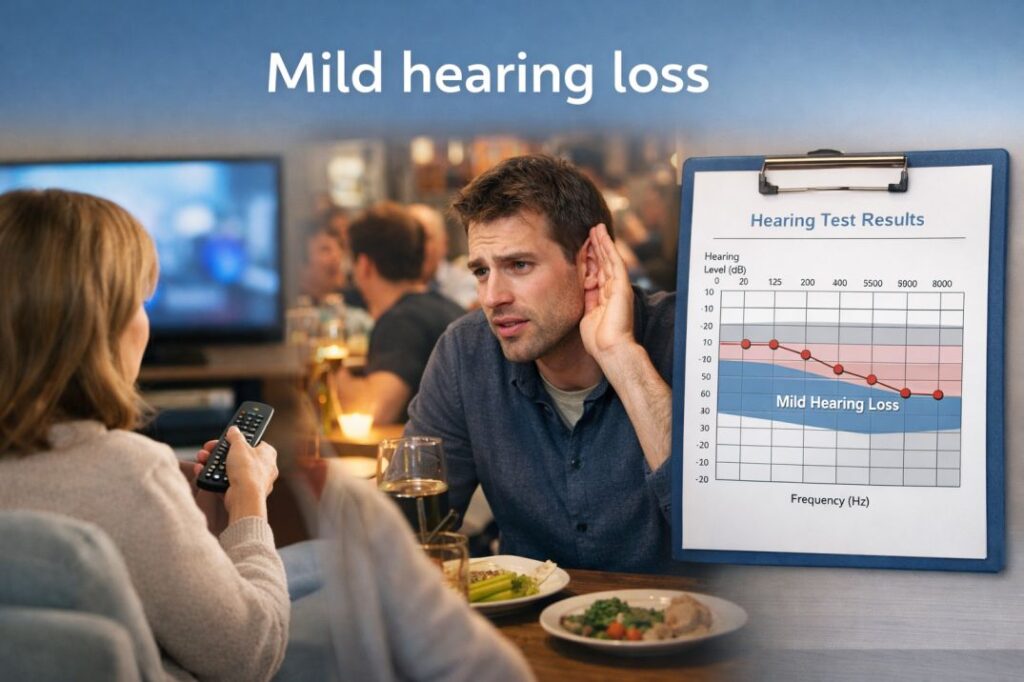
Hearing loss is classified into degrees based on your hearing threshold – the softest sound you can reliably detect. This is measured during a complete audiological evaluation and plotted on a hearing loss chart called an audiogram.
The five stages are:
Stage 1 – Mild Hearing Loss (25–40 dBHL)
This is where most people are in denial. At this level, you can still follow conversation in a quiet room. But in noisy environments – restaurants, group gatherings, phone calls – things start breaking down.
People with mild hearing loss tend to:
- Miss soft consonant sounds (like “s,” “f,” “th”)
- Struggle to hear women’s and children’s voices
- Ask people to repeat themselves regularly
- Miss whispers, dripping water, birdsong, or a ticking clock
Mild hearing loss in one ear (unilateral) can feel even more subtle, since the stronger ear compensates.
Stage 2 – Moderate Hearing Loss (41–55 dBHL)
At this level, hearing aids are strongly recommended. Moderate hearing loss makes it difficult to follow most conversations – even in relatively quiet settings. Phone conversations become a real challenge.
Stage 3 – Moderately Severe Hearing Loss (56–70 dBHL)
Without hearing aids, understanding speech becomes very difficult. Loud environmental sounds – a dog barking, a vacuum cleaner – may go unnoticed.
Stage 4 – Severe Hearing Loss (71–90 dBHL)
You cannot hear conversational speech at this stage without amplification. Powerful hearing aids are required for daily function. This is considered very hard of hearing.
Stage 5 – Profound Hearing Loss (91+ dBHL)
Profound hearing loss – or profound deafness – means the quietest detectable sound is above 90 dBHL. People at this stage often rely on cochlear implants, lip-reading, or sign language. Profound deafness is not the same as total deafness, but it is the most severe classification.
Key distinction: Hard of hearing refers to people with any degree of hearing loss from mild to severe who still use hearing as their primary communication channel. Profoundly deaf individuals often shift to visual communication methods entirely.
Signs You Might Have Mild Hearing Loss
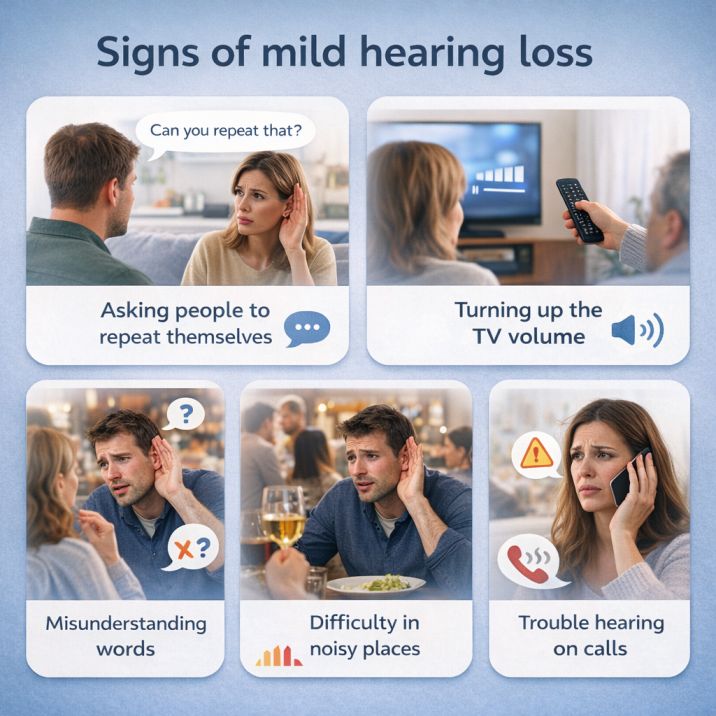
The tricky thing about mild hearing loss is how easy it is to explain away. Here’s what to actually watch for:
- Frequently asking people to repeat themselves
- Mishearing words – confusing “fifteen” for “fifty,” or missing the end of sentences
- Struggling to follow conversation when there’s any background noise
- Turning the TV louder than others find comfortable
- Feeling mentally exhausted after social events or long meetings
- Avoiding phone calls because they feel like too much effort
- Noticing it’s easier to hear men’s voices than women’s or children’s
These aren’t signs of distraction or aging you should just accept. They’re signs your hearing threshold has shifted.
For a complete understanding of the early warning signs of hearing issues, read this detailed guide: Signs of Hearing Loss
What Does Mild Hearing Loss Actually Sound Like?
Think of it like a radio that’s slightly off-tune. You can hear that words are being spoken, but catching every syllable – especially in a noisy room – takes real effort.
Most people describe it as: “I can hear, but I can’t understand.”
That’s actually one of the defining characteristics of mild hearing loss. High-frequency sounds (like the consonants “s,” “f,” “sh,” “th”) fade first. Vowel sounds – which carry more volume – stay clearer for longer. This is why speech feels muffled or like people are mumbling, even when they’re speaking at a normal volume.
This also explains the mental fatigue. Your brain is constantly working overtime to fill in the gaps, pulling cognitive resources away from memory and focus. Research links even mild hearing loss to increased risk of cognitive decline and dementia over time – not because of the ears, but because of the sustained load on the brain.
For a complete understanding of hearing loss, including its types, causes, and modern solutions, read this comprehensive guide:Hearing Loss: Types, Causes, and Solutions
Why Mild Hearing Loss Is More Serious Than It Sounds
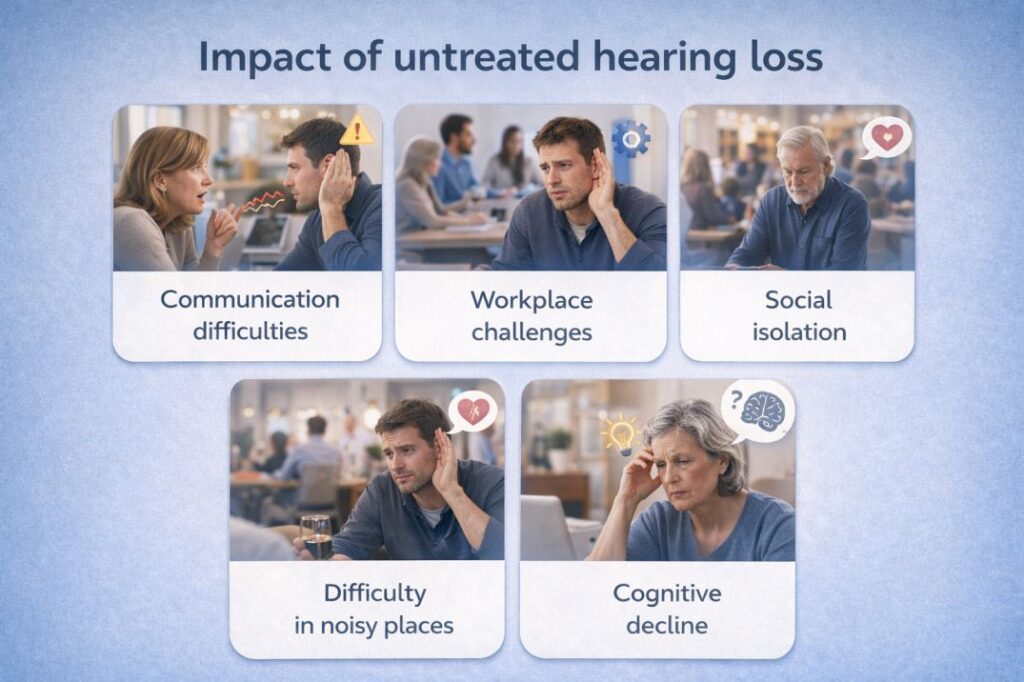
The word “mild” is misleading. It describes the degree of hearing loss, not the degree of impact on your life.
Here’s what untreated mild hearing loss actually does:
At home: Conversations with family get frustrating. Misunderstandings happen. Partners feel ignored. The TV creeps up in volume over months without anyone noticing the shift.
At work: You nod along in meetings you can’t fully follow. You miss instructions or mishear details. Research shows people with hearing loss earn on average £2,000 less per year than those without – a national figure that adds up to £4 billion in lost income in the UK alone.
Socially: Noisy restaurants, crowded parties, group conversations – all of these become draining instead of enjoyable. The natural response is to withdraw. Social isolation sets in slowly, quietly, and links directly to increased rates of depression and anxiety.
Cognitively: When the brain works harder than it should just to decode speech, it pulls resources from elsewhere. Short-term memory, concentration, and processing speed all suffer. Studies have linked even mild, untreated hearing loss to faster cognitive decline and heightened dementia risk.
And the longer someone waits, the harder treatment becomes. After years without stimulation, the brain can actually “forget” how to process certain sounds – a condition called auditory deprivation. Hearing aids then become less effective because the problem is no longer just in the ears.
The average wait time before seeking help is 7 to 10 years. By then, what started as mild hearing loss may be moderate – and the brain has already adapted in unhelpful ways.
Do You Need a Hearing Aid for Mild Hearing Loss?
Yes – for many people with mild hearing loss, hearing aids make a meaningful difference.
The answer depends on how much your hearing loss is affecting your daily life. If you’re struggling in noisy environments, feeling tired after conversations, or starting to avoid social situations, that’s the signal.
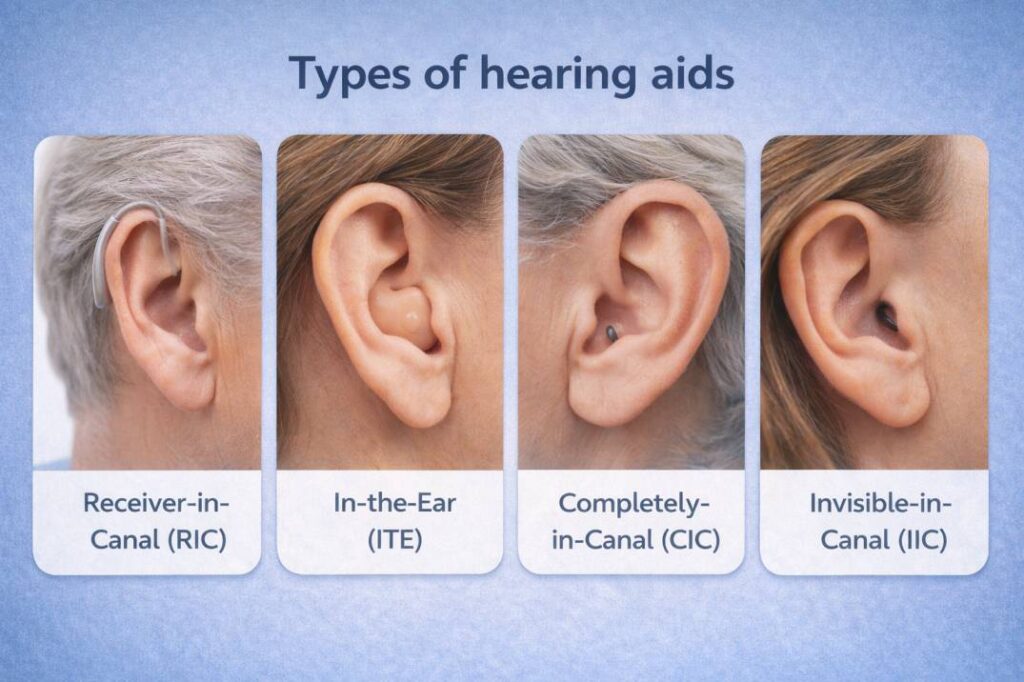
Modern hearing aids for mild hearing loss are nothing like the bulky, visible devices of the past. Today’s options include:
- Receiver-in-Canal (RIC): Slim, discreet, and highly effective for mild to moderate loss
- In-the-Ear (ITE): Custom-fitted, sits within the outer ear
- Completely-in-Canal (CIC) / Invisible-in-Canal (IIC): Virtually undetectable, ideal for mild hearing loss
Many of today’s devices use deep neural networks and AI technology to distinguish speech from background noise – making group conversations and noisy environments significantly easier to manage.
Beyond hearing aids, other tools can help:
- Auditory training apps to retrain your brain to process sound more effectively
- Assistive listening devices like TV streamers
- Caption apps for phone calls and in-person conversations
- Communication strategies like positioning yourself to see a speaker’s face
For an in-depth overview of Noise-Induced Hearing Loss, including its causes, warning signs, and preventive measures, refer to this informative article: Noise-Induced Hearing Loss
How Is Hearing Loss Diagnosed?
Diagnosing hearing loss – including mild hearing loss – requires a complete audiological evaluation conducted by an audiologist. Here’s what to expect:
- Medical history review – discussion of symptoms, duration, and any relevant health history
- Pure-tone audiometry – you listen to tones at different frequencies and volumes; results are plotted on an audiogram
- Speech audiometry – tests your ability to understand and repeat words at different volumes
- dBHL reading – your hearing threshold across frequencies determines your degree of hearing loss
The test typically takes less than an hour. It’s available through your GP referral (NHS), private audiology clinics, or hearing aid providers who offer home visits.
If you’re asking “do I have hearing loss?” – the only accurate answer comes from a proper hearing evaluation, not from self-assessment alone.
How Clarive Can Help While You Figure Out Your Next Step
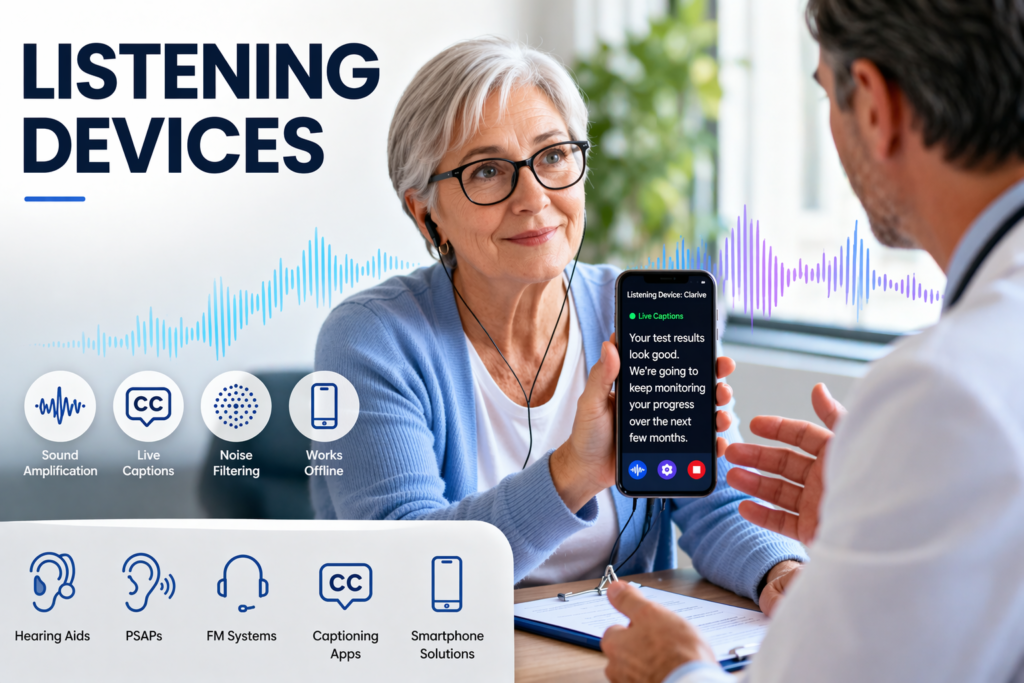
If you’re not yet ready for a formal hearing evaluation – or if you’re in situations where your hearing is already letting you down – Listening Device: Clarive gives you real support right now.
Clarive turns your phone into a smart hearing assistant. Here’s how it helps in everyday situations:
- Real-time sound amplification – whether you’re in a quiet one-on-one conversation or a noisy room, Clarive amplifies the sounds you’re missing
- Live Captions – on-screen transcription so you can follow along even when your ears can’t keep up
- Voice amplifier controls – adjust amplification to match the environment
- Works with any earphones – wired or wireless, no special hardware needed
- No internet. No account. No complicated setup – just open the app and hear better
Clarive is designed specifically for people who are hard of hearing, dealing with decreased hearing, or managing any level of hearing loss – and for anyone who simply wants clearer sound in daily life. From classrooms to conversations, from a noisy café to a family dinner, Clarive is there when you need it.
Free access includes both the Hearing Aid and Live Caption features up to 5 times per day. For unlimited use, plans start from $5.99/month.
Clarive doesn’t replace a hearing evaluation – but it gives you real support while your hearing is a work in progress.
To understand how assistive listening devices can improve hearing in different environments, refer to this comprehensive article:Listening Devices for Hard of Hearing
Conclusion
Mild hearing loss is the most common and most underestimated form of hearing difficulty. The word “mild” makes it easy to dismiss. But the impact – on your relationships, your career, your mental health, your cognitive function – is anything but mild.
The five stages of hearing loss run from mild (25–40 dBHL) all the way to profound (91+ dBHL). Most people spend years in the early stages without ever taking action, and that delay makes everything harder to treat.
Here’s what to do:
- If you’re noticing signs – get a proper hearing evaluation. It takes less than an hour.
- If you already know you have mild hearing loss – explore hearing aids sooner, not later.
- If you want support right now, in daily life – try Listening Device: Clarive. Amplify what you’re missing, read what you can’t catch, and stay in the conversation.
Your hearing matters today – not just when it gets worse.
Related post-Why Millennials and Gen Z Are Experiencing Hearing Loss Earlier
FAQs
What is mild hearing loss?
Mild hearing loss means you can’t detect sounds softer than 25–40 dBHL. You may still follow quiet conversations but struggle in noisy places, on phone calls, or with soft voices.
What is normal hearing in decibels?
Normal hearing is defined as detecting sounds at 0–20 dBHL. Anything above 25 dBHL consistently indicates some degree of hearing loss, starting with mild hearing loss.
What are the 5 levels of hearing loss?
The five stages are: mild (25–40 dBHL), moderate (41–55 dBHL), moderately severe (56–70 dBHL), severe (71–90 dBHL), and profound (91+ dBHL), each with increasing communication difficulty.
Do you need a hearing aid for mild hearing loss?
Not always – but often yes. If mild hearing loss is affecting your daily conversations, social confidence, or mental energy, hearing aids for mild hearing loss can make a significant difference.
What does profound hearing loss mean?
Profound hearing loss means the softest detectable sound is 91 dB or louder. People with profound deafness often rely on cochlear implants, lip-reading, or sign language to communicate effectively.
What is dBHL and how does it relate to hearing loss?
dBHL stands for decibels hearing level – the audiological unit used to measure your hearing threshold. Your dBHL score across frequencies determines your hearing loss classification and treatment needs.
How is hearing loss diagnosed?
A complete audiological evaluation includes pure-tone audiometry and speech audiometry. Results are plotted on an audiogram and compared to normal hearing thresholds to identify degree and type of loss.
What sounds can’t adults with mild hearing loss hear?
People with mild hearing loss commonly miss whispered conversations, birdsong, dripping water, soft consonants in speech, and women’s or children’s voices – particularly in noisy settings.
What is the difference between hard of hearing and profoundly deaf?
Hard of hearing describes anyone with mild to severe hearing loss who still uses hearing as their main communication method. Profoundly deaf individuals typically rely on visual communication like sign language.
Can mild hearing loss get worse if left untreated?
Yes. Untreated mild hearing loss can progress to moderate or severe loss over time. The brain also undergoes auditory deprivation, making sounds harder to process even with amplification later on.